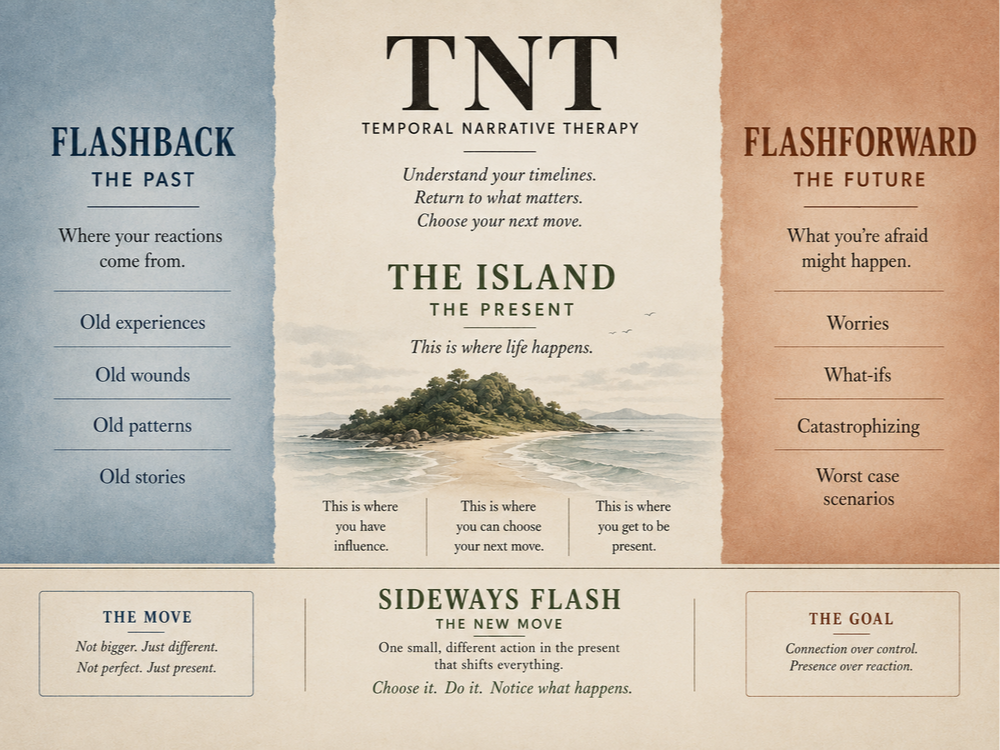
Temporal Narrative Therapy (TNT)
Stop repeating the same patterns. Start changing them.
Most people who reach out for therapy already have insight.
They’ve thought about their patterns.
They can explain where things come from.
They know what’s not working.
And still—when it matters most—they find themselves:
reacting the same way
having the same arguments
ending up in the same place
That’s where this approach comes in.
What Is Temporal Narrative Therapy?
Temporal Narrative Therapy (TNT) is a practical way of understanding why patterns repeat—and how to change them in real time.
Instead of focusing only on the past, or only on coping skills, we look at how your experience is shaped across three timelines:
Past – patterns that were learned and still show up
Present – how those patterns play out in real time
Future – expectations about how things will go, often without you realizing it
Most of the time, these timelines are overlapping.
You’re not just reacting to what’s happening now.
You’re reacting to what it reminds you of—and what you expect will happen next.
TNT helps you see that clearly.
Why Insight Alone Isn’t Enough
Understanding a problem is not the same as changing it.
You can know exactly why you shut down, overreact, or pull away—and still do it again in the moment.
That’s because patterns don’t just live in your thoughts.
They show up in:
your body
your reactions
your timing
the way you interpret other people
When something gets triggered, it happens fast.
You don’t get time to sit back and think it through.
So the work isn’t just about insight.
It’s about learning how to notice the pattern while it’s happening—and doing something different right there.
What We Actually Do
In therapy, we focus on a few key things:
Identify the pattern you’re stuck in
Slow it down so you can see what’s happening
Notice what pulls you into it
Practice a different response in real time
This isn’t about being perfect.
It’s about interrupting the loop.
Even small shifts—caught earlier, handled differently—start to change the pattern over time.
What This Looks Like in Real Life
You might notice:
catching yourself before you shut down in a conversation
saying something directly instead of avoiding it
staying present instead of overthinking or checking out
responding differently in an argument, even slightly
Those moments matter more than big insights.
They’re what actually change how your life feels.
How This Connects to Men’s Counseling Needs
A lot of the men I work with are:
thoughtful
self-aware
capable
And still feel stuck.
They’ve done a lot of thinking—but not much has changed.
TNT works well here because it’s:
direct
practical
focused on what actually happens in real time
You don’t have to over-explain everything.
We focus on what’s not working—and what to do differently.
→ Learn more about therapy for men in Kansas City
How This Shows Up in Couples Therapy
Most couples don’t have new problems.
They have the same problem, over and over.
Different wording. Same pattern.
TNT helps you:
see the pattern between you
understand what each person is reacting to
slow it down enough to respond differently
That’s where things start to shift.
→ Learn more about couples therapy in Kansas City
You Might Benefit From This Approach If:
You feel stuck in the same patterns, even with insight
You overthink but don’t see real change
You have the same arguments or reactions over and over
You feel clear one day and back to square one the next
A Different Way to Approach Change
Change doesn’t usually come from a single breakthrough.
It comes from:
noticing something a little earlier
staying with it a little longer
responding a little differently
Over time, those shifts add up.
And the pattern starts to loosen.
If You’re Ready to Start
You don’t need to have everything figured out.
You just need a place to start working on what’s actually happening.
If this approach makes sense to you, therapy can help you begin changing the patterns you’ve been stuck in.
This approach is part of how I work with men and couples in Kansas City, and is integrated throughout the Pop Therapy Blog.