Before the Algorithm Knew Us: Gen X and the Last Shared Childhood
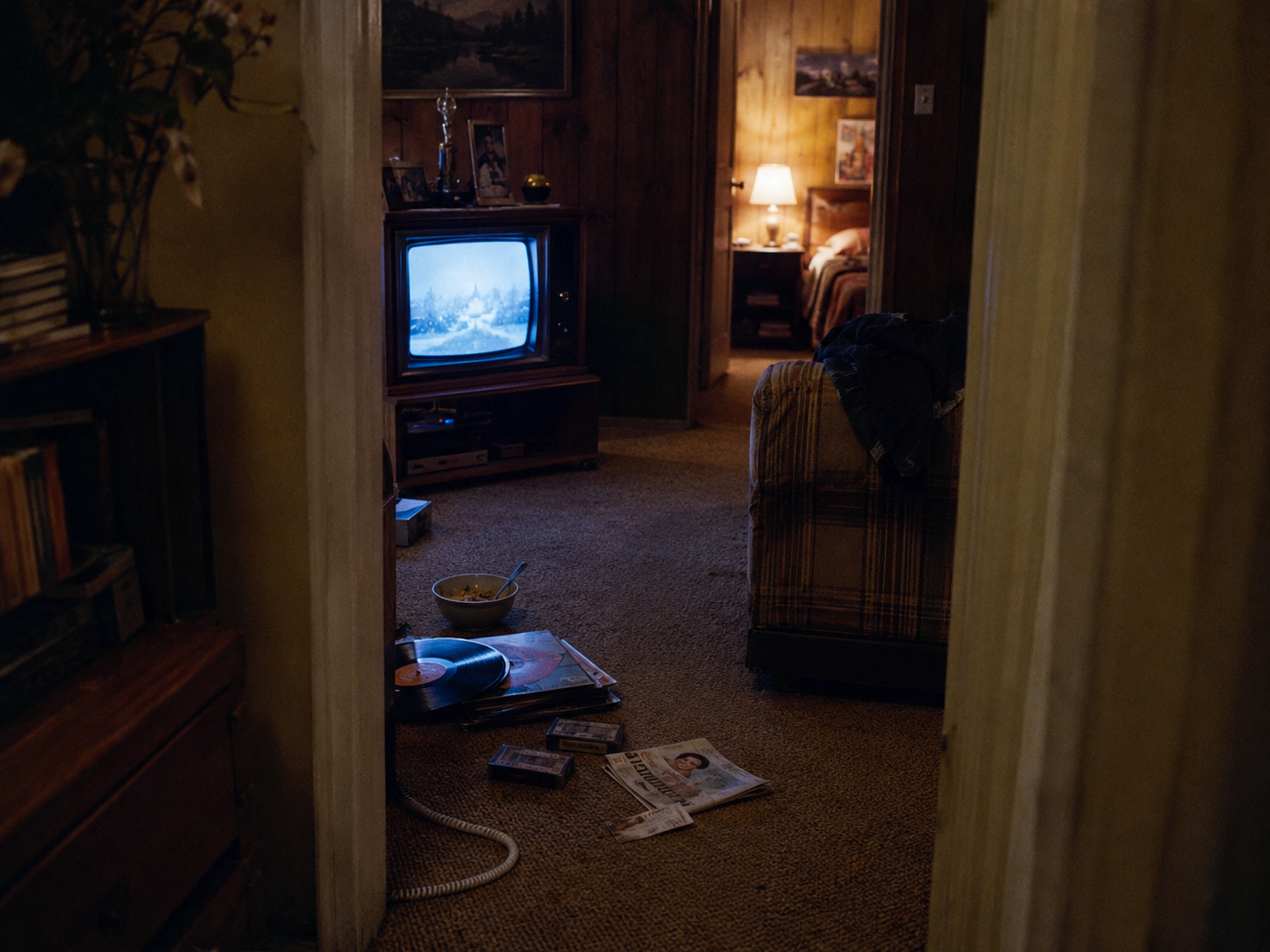
Before the internet age, popular culture did more than entertain us.
It helped organize time.
Saturday morning meant cartoons. Sunday night might mean The Wonderful World of Disney. A particular evening belonged to a particular television show. The radio sounded different at night than it did during the day. New music arrived on Tuesdays. A movie disappeared from the theater, and you had no idea when you would get another chance to see it.
Popular culture was something you waited for.
That waiting created a strange kind of power. A television show, record, magazine, or movie could become part of an entire generation’s inner life because millions of people encountered it at roughly the same time.
We were not all watching the same things. America has never been that simple. Race, geography, class, religion, gender, and family culture all shaped what entered a particular home.
But compared with today, the funnel was narrow.
There were fewer channels, fewer nationally distributed magazines, fewer ways to discover music, and almost no ability to summon exactly what you wanted at the moment you wanted it.
Because the funnel was narrow, certain things slipped through it and landed almost everywhere.
That is how The Brady Bunch became a language.
You may not have loved it. You may not even remember watching it deliberately. But say “Marcia, Marcia, Marcia” to a room full of Gen Xers and something lights up. The phrase belongs to no single person. It floats somewhere between us.
THE INVENTION OF THE TEENAGER
Popular culture did not begin in the 1950s.
Earlier generations had movies, radio serials, comic strips, jazz, swing, movie stars, pulp magazines, and fan clubs. Radio and cinema had already made it possible for people living hundreds of miles apart to hear the same voices and recognize the same faces.
What changed after World War II was the emergence of the teenager as a distinct cultural category.
Young people had always existed, of course. But the postwar teenager was increasingly treated as someone with separate music, clothing, language, desires, and money to spend. Advertisers began studying teenagers as a market. Record companies, clothing manufacturers, magazines, movies, and television programs began speaking directly to them.
Rock and roll was central to this change.
The music drew heavily from Black rhythm and blues, gospel, country, and other American traditions, but the expanding recording industry packaged it as the sound of a new youth identity. Parents often heard danger or noise. Teenagers heard a world that belonged to them.
The baby boomers became the first generation to experience modern teenage culture at an enormous national scale.
They had Elvis, James Dean, American Bandstand, transistor radios, drive-ins, and eventually the Beatles arriving on The Ed Sullivan Show. Popular culture was no longer simply something young people enjoyed. It became one of the primary ways they separated themselves from adults.
Each generation after that would have its own version.
But Gen X inherited something especially peculiar: a culture still shaped by mass broadcasting, followed by the gradual realization that the center was not going to hold.
SATURDAY MORNING WAS A PLACE
For Gen X children, Saturday morning cartoons were not merely a collection of programs.
They were a location in time.
You woke up earlier for cartoons than you would wake up for school.
You sat in front of the television with a bowl of cereal while the rest of the house remained quiet. There was no menu containing every cartoon ever made. You watched what the networks had decided children would watch that morning.
By the time Gen X came along, the Saturday morning ritual was thoroughly established.
The shows varied depending on exactly when you were born: Scooby-Doo, Super Friends, The Bugs Bunny/Road Runner Show, Fat Albert, Hong Kong Phooey, Land of the Lost, The Krofft Supershow, Schoolhouse Rock!, The Smurfs, The Jackson 5ive, Josie and the Pussycats.
The commercials were part of the experience. Sugary cereals, action figures, dolls, board games, toy cars, records, and impossible-looking products that never worked quite as well when they arrived at your house.
It was commercial culture aimed directly at children, but it was also a shared dream space.
The adults were somewhere else. The week had stopped. For a few hours, the television belonged to us.
Streaming offers children more choices and often much better programming. But it cannot reproduce Saturday morning because Saturday morning depended on limitation.
The shows mattered partly because you could not watch them whenever you wanted.
When the cartoons ended, they were over.
You had to go outside.
HEARING THE ADULT WORLD FROM BED
The television also created a nighttime atmosphere.
Many Gen Xers remember lying in bed while the sounds of adult television drifted down the hallway. You might hear the closing music from a MAS*H rerun, the local news, and eventually Johnny Carson’s monologue.
You were not necessarily watching any of it.
You were overhearing adulthood.
The laughter from the living room told you your parents were still awake. The television voices were low and indistinct. You might recognize Ed McMahon’s introduction or the rhythm of Carson’s delivery without understanding the joke.
Johnny Carson hosted The Tonight Show from 1962 until 1992, long enough to become part of the household atmosphere for multiple generations. His monologue often helped determine what people talked about the following morning.
That kind of cultural centrality is hard to recreate today.
There are still famous television hosts. There are still enormous audiences. But there is no single late-night voice drifting from nearly every house on the block.
The television used to be a fireplace.
Families did not always gather around it peacefully, and they certainly did not always agree about what it showed. But it sat near the center of the home and gave the night a sound.
RERUNS BECAME ANCESTRAL MEMORY
Gen X did not only watch its own culture.
We grew up surrounded by the recycled culture of the generation before us.
Afternoon television was full of Gilligan’s Island, The Munsters, Bewitched, The Addams Family, I Dream of Jeannie, Leave It to Beaver, and The Brady Bunch.
This produced a kind of flattened cultural timeline.
A show made before you were born could feel as immediate as something currently on television. A child in 1978 could watch a program from 1968 without thinking of it as an artifact.
It was simply on.
That may be part of why Gen X developed such a dense vocabulary of references. We absorbed our own childhood culture along with the leftovers of the baby boomers’ childhood.
We knew Greg Brady’s rock-star phase. We knew the tiki idol from Hawaii. We knew what happened when Marcia’s nose met a football.
We learned these things without deciding they were important.
Nobody assigned The Brady Bunch.
It simply entered the water supply.
Today, older shows remain available, but availability is different from accidental exposure. You can stream almost any program, but you usually have to choose it.
Gen X television often chose us.
MUSIC REQUIRED A LITTLE WORK
Music also arrived through narrow openings.
You heard a song on the radio and tried to catch the name. You waited for it to play again. You might hold a cassette recorder near the speaker and hope the disc jockey did not talk over the beginning.
You bought a record because you knew one song.
Sometimes you rode your bike to the record store. Sometimes you found an album at the mall. Sometimes an older sibling handed you something that seemed dangerous, strange, or far more grown-up than anything you had discovered on your own.
The effort mattered.
A record was not simply a group of audio files. It was an object with a cover, an order, a side one and a side two. Even disappointing albums demanded repeated listening because you had spent money on them.
Music scenes were also partly geographic.
You might hear punk, college rock, hip-hop, metal, goth, new wave, country, or indie music through a particular friend, record store, radio station, fanzine, club, or older kid.
Discovery involved people.
This made taste feel personal even when millions of other people were having similar experiences.
The album you found felt like your album.
The band you discovered felt like your secret.
And then, sometimes, the secret became enormous.
WHEN THE MARGINS MOVED TO THE CENTER
By the late 1980s and early 1990s, the culture began to shift.
Cable television had expanded the number of available channels, but it had not yet shattered the audience into millions of individual feeds. MTV could still make a video feel like a national event.
College radio, independent record stores, alternative newspapers, and fanzines carried ideas that had not yet been fully absorbed by mainstream culture.
A magazine like Sassy could appear on a grocery-store rack and quietly tell a teenage girl that she did not have to become the polished, agreeable person other magazines seemed to be designing.
Published from 1988 to 1996, Sassy mixed fashion and celebrity material with alternative music, feminism, awkwardness, sexuality, politics, and a tone that felt more intimate than instructional.
It became a cultural landmark partly because it understood that its readers were suspicious of the usual teen-magazine voice.
It did not speak to every girl, but the girls it reached often felt that someone had finally noticed them.
That was one of the defining feelings of Gen X culture: the sense that something made at the edges had somehow found you.
Then the edges began moving toward the center.
Alternative music became popular music. Independent style became a marketing category. Distress, irony, and alienation could suddenly be sold at the mall.
The first Lollapalooza tour in 1991 captured that transition. Originally conceived as a farewell tour for Jane’s Addiction, it put alternative rock, industrial music, rap, performance art, political organizations, and assorted pieces of underground culture into one traveling event.
It felt less like a traditional rock festival than a temporary nation.
For many people, it was the first time they stood in a large crowd and realized that thousands of others had found the same supposedly obscure things.
You were not as alone as you thought.
KURT AND COURTNEY
The relationship between Kurt Cobain and Courtney Love became another kind of generational text.
They were musicians, lovers, parents, and celebrities, but they were also transformed into symbols. In the early 1990s, the media treated them as something close to the royal couple of alternative rock.
People projected almost everything onto them: romance, danger, authenticity, addiction, ambition, misogyny, creativity, codependence, exploitation, and tragedy.
Their relationship seemed to contain the contradictions of the era.
Gen X claimed to distrust celebrity while becoming fascinated by celebrities who appeared to distrust fame.
We wanted musicians to remain real after becoming famous, an impossible assignment that often punished them for the attention we had given them.
Kurt and Courtney were not fictional characters, and the consequences of their struggles were real. But they were consumed by the culture as a story.
Before social media, we still formed intense opinions about people we did not know.
The difference was that the story arrived in installments: an MTV interview, a magazine cover, a rumor passed between friends, a photograph, an appearance at an awards show.
There was time between the fragments.
We filled the empty space ourselves.
TELEVISION WE HAD TO MEET ON TIME
The same pattern shaped television.
When Twin Peaks premiered in April 1990, viewers could not immediately search for explanations, join a worldwide discussion forum, or watch a dozen video essays decoding the red room.
They had to sit with the mystery.
The premiere pushed the question of Laura Palmer’s murder into the broader culture.
Then people talked.
At work. At school. On the phone. In a dorm room. In the smoking section of a restaurant.
The term “water-cooler television” now sounds quaint, but it describes something important. The discussion happened after the program because the program and the discussion were separate events.
You watched first.
Then you had to find another person who had watched.
Beverly Hills, 90210, which also premiered in 1990, offered another kind of shared world. It took teenage concerns seriously enough to turn them into weekly drama while still providing the fashion, beautiful people, romance, and fantasy expected from television.
A few years later, Party of Five gave young viewers something more openly wounded: siblings attempting to raise one another after the death of their parents.
It premiered in 1994, when television was increasingly willing to let young characters be complicated, grieving, and emotionally unfinished.
These shows did not simply reflect a generation.
They gave it scripts.
They showed us how friendship was supposed to sound, how romance was supposed to feel, what betrayal looked like, how attractive people suffered, and what kind of sadness could still be resolved before the closing credits.
Sometimes we recognized ourselves.
Sometimes we learned to imitate what we saw.
BEFORE WE WERE ALL OUR OWN CHANNELS
Gen X had a mostly pre-internet childhood and, for many of us, a pre-internet adolescence.
There were no profiles to maintain. You did not have to photograph an experience in order to establish that it had occurred.
Embarrassing phases could remain local.
A terrible haircut might survive in a school picture, but it did not follow you through a searchable archive.
This did not make childhood easier.
Isolation could be more intense. Young people who felt different had fewer ways to find one another. Information about sexuality, mental health, abuse, identity, or life outside a small town could be difficult to locate.
Gatekeepers controlled which voices entered mainstream culture.
The old media world was not better for everyone.
But it did contain more privacy, more disappearance, and more unrecorded time.
You could try on an identity without turning it into a permanent personal brand.
You could love a song without announcing that love.
You could go to a concert and return with only a ticket stub, a shirt, and an unreliable memory.
FROM SHARED CULTURE TO PERSONALIZED CULTURE
The internet did not eliminate popular culture.
It multiplied it.
Today, people can find music from any decade, watch television from other countries, discover obscure artists, create their own work, and build communities around interests that would once have left them isolated.
That is an extraordinary gain.
But something else has been lost.
Popular culture once arrived from outside us. Now it increasingly arrives through systems designed to study us.
The algorithm does not ask an entire generation to watch the same thing.
It builds a separate channel for each person.
Two teenagers sitting next to one another may inhabit completely different cultural worlds. They may use the same platform while rarely encountering the same music, jokes, news, celebrities, or stories.
This creates more choice, but perhaps less common language.
There are still enormous hits. There are still movies, shows, and songs that seem to appear everywhere.
But even the biggest cultural moments now compete with thousands of simultaneous realities.
We no longer gather around the same television.
The television follows each of us into a separate room.
WHAT GEN X CARRIES
This may be one reason Gen X can become unusually emotional about old television themes, commercials, magazines, mall stores, and songs.
We are not only remembering the content.
We are remembering the structure around it.
The time of day. The room. The furniture. The person holding the remote. The sound of our parents laughing after we had gone to bed. The cereal bowl on Saturday morning. The friend who made the cassette. The magazine folded inside a backpack. The unanswered phone ringing on the kitchen wall because nobody knew where we were.
We remember when popular culture felt large and distant.
We remember when seeing something required being there.
We remember believing that a strange band, television show, or magazine had somehow found us personally—even though it was finding thousands of other people at exactly the same moment.
That is the paradox of shared culture.
It made us feel individual by giving us things we had in common.
THE LAST SHARED CHILDHOOD
Gen X was not the first generation shaped by popular culture, and we will not be the last.
The baby boomers were formed by television and rock and roll. Millennials experienced the transition from analog childhood to digital adulthood. Gen Z grew up with the internet not as an invention but as an environment.
Every generation develops its own cultural language.
But Gen X may have been among the last American generations to experience childhood through a relatively small collection of national broadcasts, mass-market objects, and scheduled events—and then watch that shared world begin to splinter.
We were there for Saturday morning cartoons and the rise of cable.
We heard Johnny Carson through the wall and later watched music videos all afternoon.
We knew The Brady Bunch as reruns, Twin Peaks as a mystery, 90210 as a weekly appointment, and Lollapalooza as a traveling rumor that suddenly became real.
We remember the culture before the internet because we also remember the internet arriving.
Maybe that is why these old references still feel so powerful.
They are not just reminders of what we watched.
They are reminders of when we watched together.