
It’s Not Just Talking: How Conversation Becomes Therapeutic
Therapy is sometimes dismissed as “just talking.” But an attuned conversation can help us connect past and present, notice what the body is carrying, and see patterns that are almost impossible to recognize alone. You do not have to heal yourself alone.

The clinical moment below is a composite. Details have been changed to protect privacy.
“That’s what I’ve been doing with my daughter this whole time.”
The sentence seemed to surprise him.
He had been talking about his fears for his daughter—her choices, her future, and what might happen if she made the wrong move. As we connected the present to his own past, something came into focus. The fear did not begin with her. It had lived inside him for years.
He had been trying to protect his daughter from an old fear by placing it over her life.
I didn’t hand him that realization. I helped connect the past and the present, and then stayed with him long enough for him to hear himself.
That is one reason conversation becomes therapeutic.
The body often recognizes something first
There are moments in therapy when someone says a sentence and their body responds before they fully understand what they have discovered. They may laugh and not know why. They may suddenly feel hot. Sometimes a quizzical smile appears, as if one part of them has recognized the truth while the rest is still catching up.
My clients know that I am always asking, “Where do you feel that in your body?” I ask partly as a way of de-compartmentalizing. A person can tell a clear, organized story from the neck up while their chest tightens, their stomach drops, or their hands curl into fists beneath the story.
Thoughts, feelings, memories, and physical reactions do not live in separate rooms, even when we have learned to treat them that way.
Asking about the body brings those rooms back together.
The unexpected laugh does not necessarily mean something is funny. The heat does not mean the conversation has gone wrong. These reactions may be telling us that a familiar story is being experienced differently. Something that had been carried privately is now being spoken in the presence of another person.
The person is no longer alone inside it.
Another person can hear what you cannot
When we are living inside a pattern, we rarely experience it as a pattern. It simply feels like reality.
We know our own history too well. We carry every old explanation, fear, loyalty, and reason we had to adapt. All of that can make it almost impossible to see what we are repeating. We may think we are responding only to what is happening today when the past is also sitting in the room.
Another person listens from a different position. A therapist can hear the words that keep returning, notice where the story speeds up, and wonder why one moment carries so much weight. Therapy creates room to ask:
Is this feeling only about what is happening now?
When have you felt this before?
What are you trying to prevent?
Who are you afraid you—or someone you love—might become?
The therapist’s job is not to announce the answer. It is to hold the thread long enough for the person to recognize where it leads.
Sometimes pop culture is the side door
Rapport building around pop culture is not filler while we wait for the “real therapy” to begin. Sometimes it is the therapeutic gateway.
A person may be able to talk about why Jack on LOST has to fix everyone before they can name what it costs them to always be the fixer. They may laugh about Michael Scott’s desperate need to be liked on The Office before talking about their own fear of rejection. They may debate whether Ross and Rachel were on a break, only to find themselves talking about assumptions, loyalty, and the unwritten rules in their own relationships.
Pop culture gives us a little distance. We can look at someone else’s story before the spotlight turns back toward our own.
Sometimes the weird thing is the doorway to the real thing.
The shared reference also tells the person something important: You do not have to translate your entire inner world into clinical language to be understood here. We can begin with the show you rewatch, the song that still gets to you, or the character you defend more strongly than you expected.
Then we get curious about why.
Attunement helps us stay
Perspective is only part of what another person provides. The other part is attunement.
Attunement means someone is paying attention not only to the facts of your story, but also to what is happening inside you as you tell it. They notice when you speed up, go blank, make a joke, change the subject, or begin to disappear from the room emotionally. They remain interested without becoming alarmed or turning away.
That steady presence helps co-regulate the nervous system. The anxiety may not vanish, but it can become manageable enough to stay curious. Instead of immediately escaping, shutting down, or pushing the feeling away, you have a different experience: discussing something painful while remaining connected to a calm and responsive person.
Talking does not erase trauma. But talking about it in an attuned relationship changes the conditions under which it is experienced. The old alarm goes off, but this time you are not alone. You can notice the urge to flee without immediately obeying it. You can feel the heat, hear the nervous laugh, and stay for the next sentence.
You cannot run away—at least not quite as easily.
This is one of the quiet ways therapy interrupts avoidance.
Different struggles, a similar process
Someone may begin therapy looking for treatment for anxiety or depression. Someone else may be struggling with relationship patterns, midlife identity issues, or the restless fear of missing out we now call FOMO.
Anxiety often tells us that something terrible will happen if we stop scanning, planning, or controlling. Depression can shrink the future until change feels pointless. Midlife identity issues can make us wonder whether we chose our life or simply became very good at performing a role. FOMO may be less about missing tonight’s event and more about grief for the unlived lives we can still imagine.
These are different struggles. But the therapeutic process often shares a shape: an experience that has remained private becomes speakable. The body joins the conversation. Another person helps connect past and present. What felt like reality begins to look like a pattern.
Once we can see the pattern, we are less likely to act it out without knowing it.
Can you heal yourself?
“Heal yourself” is everywhere right now. I understand why the phrase appeals to people. It offers hope and agency. It says that your life is not permanently controlled by what happened to you.
But it can also sound like another demand: Fix yourself privately. Do recovery correctly. Stop needing anyone.
That misses something important. Many of the fears we carry were formed in relationships, strengthened in relationships, or kept alive by what could not be said in relationships. It makes sense that some healing also happens in a relationship.
You do not have to heal yourself alone.
The goal of therapy is not to need a therapist forever. The goal is to have repeated experiences of noticing what is happening, staying present, making meaning, and choosing instead of automatically reacting. What first requires the steady presence of another person can gradually become something you are better able to do for yourself.
Before a difficult conversation, fear predicts catastrophe: If I say this out loud, I will lose control. I will fall apart. I will be judged. I will discover something I cannot handle.
Then you begin talking. We move through the anxiety instead of waiting for it to disappear first. The fear subsides. You remain intact. Often, you understand yourself more clearly than you did before.
That experience produces confidence: Maybe I can stay with this. Maybe I can recognize the pattern sooner next time. Maybe I can do more of this for myself.
Conversation is not the warm-up
People sometimes describe therapy as “just talking,” as if the conversation is what happens before the real intervention begins.
But the conversation can be the intervention.
It gives private experience language. It brings the body back into the story. It places an old fear inside a new relationship. It uses a father’s worry, a joke, a nervous laugh, or even a conversation about LOST as a way into something that has been difficult to approach directly.
Sometimes change begins with a dramatic realization. More often, it begins quietly: a flush of heat, a puzzled smile, or a sentence you did not know you were ready to say.
Then you hear yourself.
The present is not where the story started. But it is the only place where a different choice can be made.
Perhaps healing begins less with “Here is who I should become” and more with a simpler declaration:
I am HERE AS I AM NOW.
From here, I can see the pattern.
From here, I can change what comes next.
Find the pattern. Change what comes next.
Ready to start a conversation? Learn more about working with me.
Juliet Burke and the Slow Disappearance of Yourself
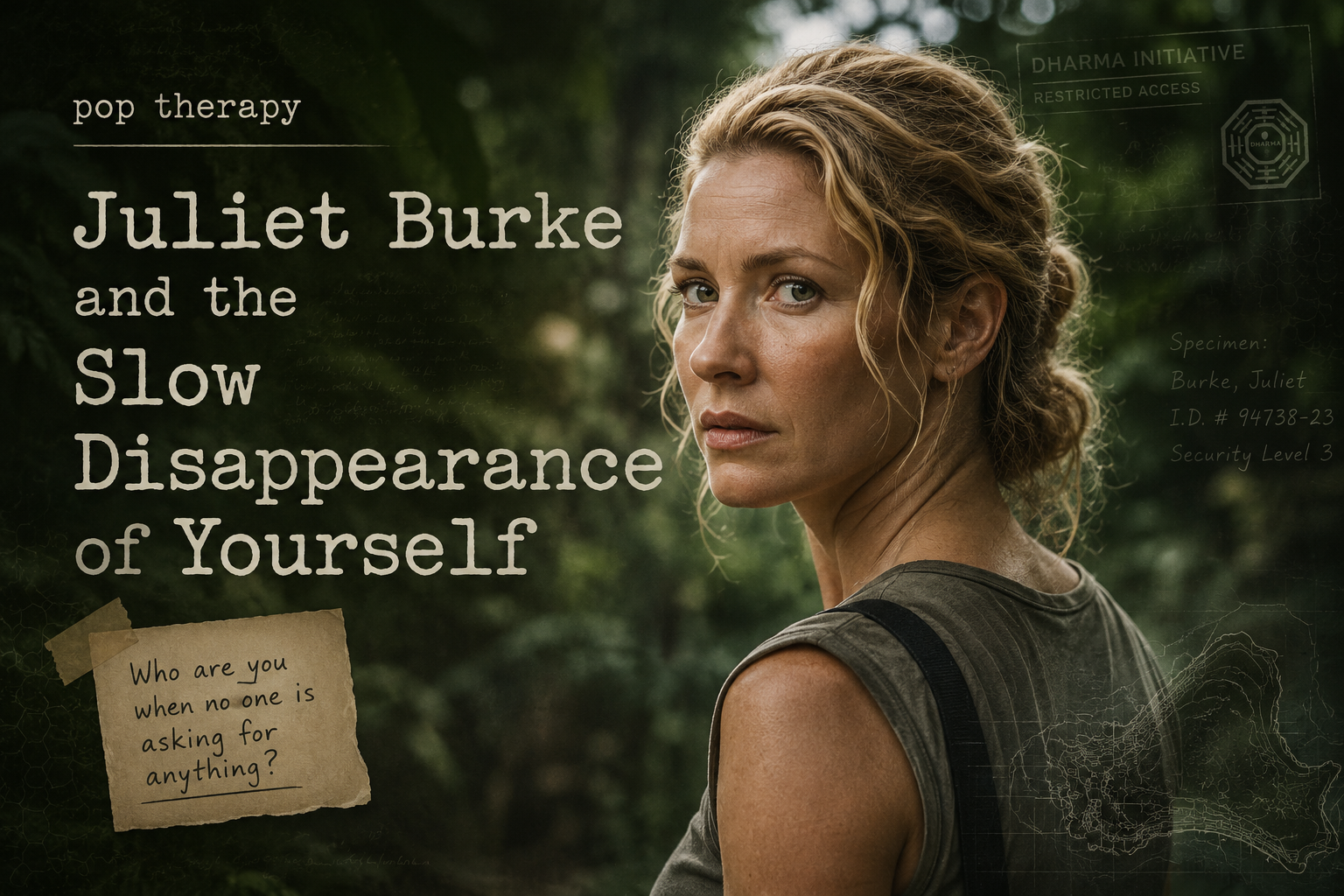
Most people see Juliet as someone who gave up everything for love, but I don’t think that’s really her story. It feels more like she spent years becoming whoever the people around her needed her to be until she slowly forgot she had once been someone else. Ben needed something from her. The Others needed something from her. The fertility project needed something from her. Jack did. Sawyer did. Even the people who genuinely cared about her often leaned on the version of Juliet who could solve problems, keep going, and carry more than her share.
I see that same pattern in therapy. These aren’t dramatic stories. They’re usually thoughtful, capable people who have become so good at adapting that everyone naturally begins relying on them. They read the room before anyone else does. They say yes almost automatically. They anticipate what other people need before they’ve even considered what they need themselves. Over time, a quiet kind of exhaustion settles in. Eventually they say something that almost feels embarrassing to admit out loud: “I don’t really know what I want anymore.”
One of the things LOST understood so well is how identity slips away. It usually isn’t one life-changing event. It’s a thousand small decisions that all make perfect sense in the moment. You accommodate. You adjust. You keep the peace. You tell yourself it’s temporary. Then one day you realize those decisions have started to feel more familiar than the person who made them. Juliet spends much of the series living inside stories that other people have written for her. Ben writes one version. The Island writes another. Even love can become another script if you’re not paying attention.
Therapy isn’t always about dramatic breakthroughs, either. Sometimes it’s simply noticing how many of your choices are driven by avoiding disappointment, conflict, guilt, or rejection. The voice underneath all of that is usually still there. It’s just gotten quieter over the years. Losing yourself rarely happens all at once, and finding yourself again usually doesn’t either. It often begins with one honest conversation. One unexpected no. One decision that isn’t made to keep everyone else comfortable.
That’s the part of Juliet’s story that has stayed with me. Most of us aren’t trying to escape a mysterious island. We’re just trying to remember who we were before we became so good at fitting ourselves around everyone else’s expectations.
Interested in giving therapy a try? I offer a free consultation to see if things are a good fit.