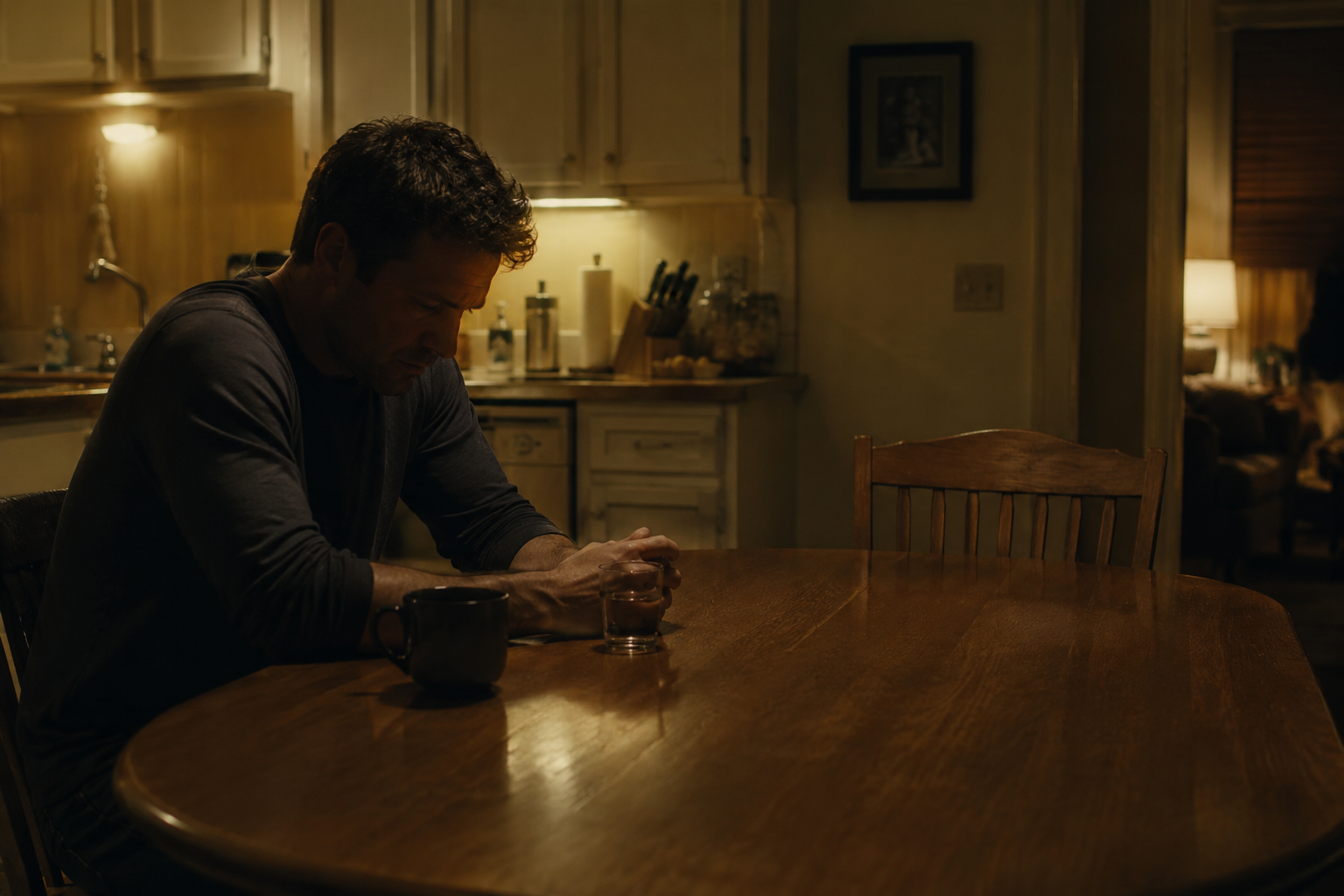
A lot of men tell me they have trouble being vulnerable, although they usually don’t say it exactly that way. More often I hear things like, “I don’t know what I’m feeling,” “I’m just not very emotional,” or “My wife wants me to open up, but I don’t know what she wants me to say.” Sometimes they simply say, “I’m fine.” And sometimes they really are fine. But sometimes “fine” means something happened so quickly inside them that they never had a chance to put words around it.
That is the part I’m interested in. I don’t think emotional vulnerability starts with sitting across from someone and revealing your deepest secret. For a lot of men, that would be starting at chapter twelve. I’m more interested in what happens thirty seconds before you shut down, get irritated, start explaining yourself, make a joke, pick up your phone, or leave the room.
Your wife asks why you seem distant. Your boss questions something you did. Your kid ignores you for the third time. Someone makes a comment that lands harder than you expected. Maybe your chest tightens. Maybe you feel hot. Maybe you suddenly want the conversation to be over. Maybe your mind immediately starts building a case for why the other person is wrong. Then comes the response: “I don’t want to talk about this.” “You’re making too big a deal out of it.” “I said I was sorry.” “Whatever.” Or maybe you don’t say anything at all.
That moment often gets described as an anger problem, a communication problem, or an inability to express feelings. Sometimes there is more going on. You got hurt, embarrassed, scared, rejected, or overwhelmed, and you got away from that feeling so quickly that anger, silence, logic, humor, work, your phone, or leaving the room took its place. The whole process can happen in seconds.
Many men get very good at this, and there are reasons for that. Boys often learn early which emotions are easier to show and which ones make them feel exposed. Anger can feel active and powerful. Sadness can feel much riskier. Solving a problem feels useful. Saying, “That hurt me,” may feel unfamiliar or even embarrassing. Over time, you learn to explain instead of feel, defend yourself instead of admit that you are embarrassed, become irritated when you are actually scared, or say you don’t care when caring feels dangerous.
Eventually, this may not even feel like something you are doing. It just feels like your personality. “I’m not a feelings guy.” Maybe. But I have met plenty of men who say they aren’t emotional while being angry for three days because their teenager barely spoke to them at dinner. The emotion is there. The problem is often getting access to it before something else takes over.
This is where vulnerability can become much more practical than people imagine. You don’t have to immediately produce a perfect explanation of what is happening inside you. You can start by catching the moment before your usual response. Maybe you notice, “My stomach dropped when she said that,” or, “I suddenly felt like I was being blamed.” Maybe you realize, “I wanted to get out of the room,” or, “I wanted to prove I was right.” Sometimes the most useful observation is also the simplest: “I felt stupid.”
Other feelings can be harder to admit. “I felt left out.” “I was jealous.” “I thought you were disappointed in me.” “I wanted you to notice me.” “I was afraid you didn’t need me.” These are ordinary human experiences, but many men have spent years translating them into something that feels safer. Jealousy becomes criticism. Fear becomes control. Hurt becomes distance. Shame becomes defensiveness. Loneliness becomes staying at work later.
None of this means every angry or quiet man secretly needs to cry. That isn’t the point. The goal is simply to get more accurate. If I am hurt but call it anger, I am probably going to do something with anger. If I am scared but tell myself I am annoyed, I will behave like an annoyed person. If I feel rejected but convince myself that I don’t care, the person I actually want connection with may experience me as distant. Getting the feeling right gives you more choices about what happens next.
You can practice this without becoming a different person. The next time you notice yourself getting defensive, don’t force yourself to explain everything. Try adding one honest sentence: “That actually embarrassed me.” “I know I seem angry, but I think I’m overwhelmed.” “I want to answer you, but right now I mostly want to shut down.” “I’m having a bigger reaction to this than I expected.” That is vulnerability too.
It may not look dramatic. Nobody needs to give a speech. Sometimes vulnerability is simply staying in the room ten seconds longer than you normally would. It is noticing the joke you were about to make because the conversation got uncomfortable. It is realizing that your long explanation is partly an attempt to make sure nobody thinks badly of you. It is being able to tell your partner, “I don’t know what I’m feeling yet, but I know something is happening.”
In therapy, this is often where we begin. Not with “Tell me everything.” More often, we slow down one of those moments and look at what happened right before you disappeared. What did you notice in your body? What did you assume the other person was thinking about you? What did you want to do next? What might you have said if you had not needed to protect yourself quite so quickly?
Those questions can uncover a lot. A man who thinks he has an anger problem may discover how easily he feels dismissed. A man who believes he is emotionally detached may realize how much rejection he expects. A man who shuts down during conflict may begin to notice the shame that arrives just before the silence. Once you can see the sequence, you have a better chance of changing it.
That is one of the things I like about therapy. You don’t have to become a completely different person, and you don’t have to suddenly become comfortable talking about every emotion you have ever had. You start by slowing down something that has been happening very fast. You get curious about the few seconds between what happened and what you did next.
Thirty seconds can be enough. Enough time to notice what is happening. Enough time to name something more accurately. Enough time to choose a different sentence or stay in the conversation a little longer. Over time, those small moments can change the way you handle conflict, closeness, anger, embarrassment, rejection, and the people who matter most to you.
If you recognize yourself somewhere in this, therapy doesn’t have to begin with knowing exactly what you want to talk about. We can start with the moments that keep repeating and figure out what is happening inside them.
Find the pattern. Change what comes next.
Interested in Therapy in Kansas City? Click to set up a free consultation.