Jin Kwon The Man Who Thought Love Meant Disappearing Into Duty
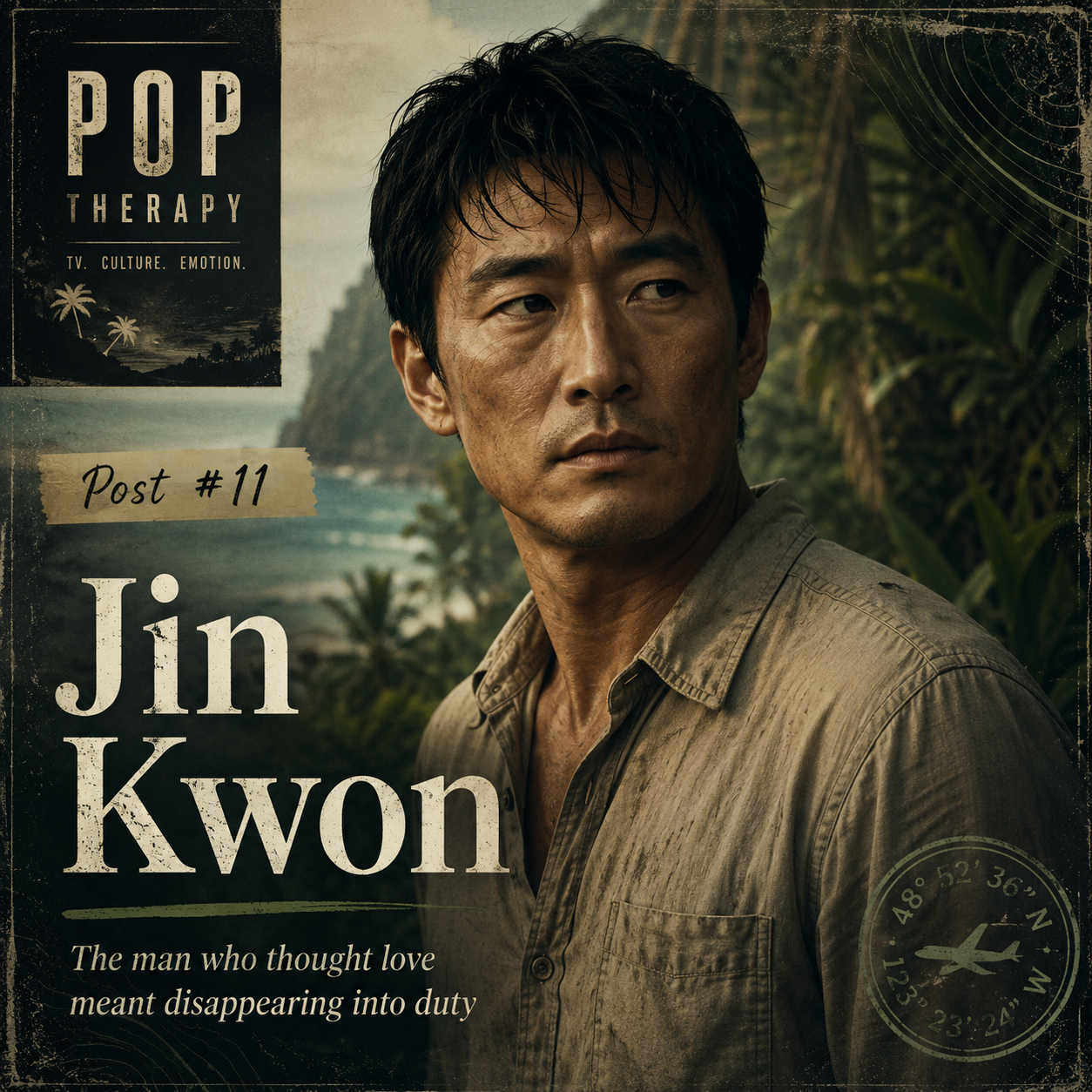
Jin Kwon is easy to misunderstand at first, which is also sort of the point. When we meet him, he seems rigid, controlling, even cold. He watches Sun closely. He tells her what to do. He appears to be the old-world husband who cannot tolerate his wife having a self of her own. And, yes, some of that is there. The show does not let him off the hook, and I don’t think we should either. But Lost is rarely interested in letting first impressions stay intact. The longer we sit with Jin, the more we realize that what looks like control is also shame, class injury, fear, love with nowhere clean to go, and a man who has been taught that tenderness is something you prove by suffering silently.
Before the Island, Jin is a man trying to climb into a life he does not quite believe he deserves. He is the son of a fisherman, ashamed of where he comes from, ashamed of what others might see in him, and desperate to become acceptable in Sun’s world. He does not begin as some cartoon brute. He begins as a man in love who wants to be worthy, which is one of the more dangerous things a person can want if they have no language for their own worth. Wanting to be worthy can become devotion, but it can also become obedience to cruel systems. It can become a job you hate, a version of yourself you barely recognize, a suit you put on until you forget what your own skin feels like underneath.
That is part of what makes Jin’s story so painful. He thinks he is protecting his marriage by doing the very things that destroy it. He works for Sun’s father. He becomes hardened by the work. He absorbs humiliation and violence and then brings that hardness home. He does not tell Sun what is happening because, in his mind, telling her would burden her, or expose him, or reveal that he is not the man he is trying so desperately to become. So she experiences his silence as rejection. He experiences his silence as sacrifice. This is the kind of marital tragedy that happens all the time, even without plane crashes and hatches and smoke monsters. One person says, “I did all this for you,” while the other person is thinking, “But where did you go?”
There is a particular kind of man who believes love is proven through endurance. He may not say it that way. He may not even know he believes it. But somewhere inside him is a rule: don’t complain, don’t explain, don’t need too much, don’t fall apart, just keep going. It can look noble from the outside for a while. It can even be useful. Families survive because somebody gets up and goes to work, pays the bill, makes the call, fixes the thing, carries the heavy box, keeps the machine moving. But when duty becomes the only available language, love starts to get strangely lonely. The people closest to him may be cared for in practical ways and still feel emotionally abandoned.
Jin and Sun become a couple fluent in each other’s defenses but not each other’s hearts. She hides her English. He hides his shame. She plans an escape. He doubles down on the role he thinks will save them. Both of them are living in a marriage full of untranslated sentences. That is one of the more quietly brilliant parts of their story. Language is not just Korean and English here. Language is emotional language. It is the difference between “I am angry” and “I am scared I am not enough.” It is the difference between “you betrayed me” and “I thought I had already lost you.” It is the difference between “I am doing this for us” and “I don’t know how to let you see me failing.”
The Island begins to change Jin because it takes away the old scoreboard. Status does not mean much when everyone is sweating through the same clothes and trying not to get eaten by whatever is moving around in the trees. The things that made him feel small or powerful in the regular world become less useful. He cannot impress Sun’s father there. He cannot work his way into respectability through money. He cannot hide forever inside duty. On the Island, Jin has to become known in other ways. He fishes. He helps. He struggles. He gets jealous. He makes mistakes. He begins, slowly, to become a person instead of only a role.
That is the part I find moving about him. Jin does not transform through some neat therapeutic breakthrough where he suddenly finds the perfect words and everyone claps. His change is slower and more awkward than that, which makes it feel more honest. He learns by doing. He learns by being humbled. He learns through friendship, through failure, through grief, through the terrible realization that love cannot be protected by refusing to be vulnerable. There is something almost old-fashioned about his arc, like a song you forgot was on the second side of a cassette and then it catches you off guard while you’re driving around at dusk. Not flashy. Not clean. But it stays with you.
In therapy, I think a lot about men like Jin. Not because they are all secretly noble or misunderstood, and not because harm gets erased if we can explain where it came from. Explanation is not absolution. But if we only look at the behavior from the outside, we miss the machinery underneath it. Control may be control, but it may also be panic wearing a uniform. Silence may be silence, but it may also be a man trying to keep his shame from spilling onto the floor. Anger may be anger, but it may also be the only emotion he was ever allowed to carry in public.
The work, then, is not to applaud the suffering or excuse the damage. The work is to help a man come out from behind the role before the role costs him everything. For Jin, the role is husband, provider, protector, man of honor, man who can withstand anything. Those roles are not bad by themselves. They only become dangerous when they leave no room for softness, apology, confusion, dependence, or repair. A man can become so committed to being strong that he becomes unreachable. Then the people who love him are left trying to have a relationship with his armor.
Sun and Jin’s story is ultimately not about a bad husband becoming a good husband in some simple moral arc. It is about two people trying to find each other after years of hiding in plain sight. It is about how marriage can become a place where both people are lonely for different reasons. It is about the strange grief of realizing the person you loved was there the whole time, but buried under fear, pride, family pressure, and a thousand unsaid things. Their love is not sentimental because it has too much wreckage in it. It has betrayal in it. It has control in it. It has secrecy in it. And still, somehow, it also has devotion.
That is why Jin matters. He reminds us that change is not always a person discovering a brand-new self. Sometimes change is a person returning to the self that got covered over by shame. Sometimes it is learning that being loved is not the same thing as being useful. Sometimes it is realizing that the people closest to us do not need us to disappear into sacrifice. They need us to come back, sit beside them, and tell the truth in whatever broken language we have available.
Jin’s tragedy is that he had to lose so much before he could become reachable. His gift is that he did become reachable. Not perfectly. Not magically. Not without causing pain. But enough for us to see the man beneath the duty, the husband beneath the armor, the frightened son beneath the clenched jaw. And maybe that is why his story still works. Because somewhere in him is the part of us that thought love meant carrying everything alone, when what we really needed was to turn toward someone and let them see the weight.