Charlie Pace and the Need to Matter
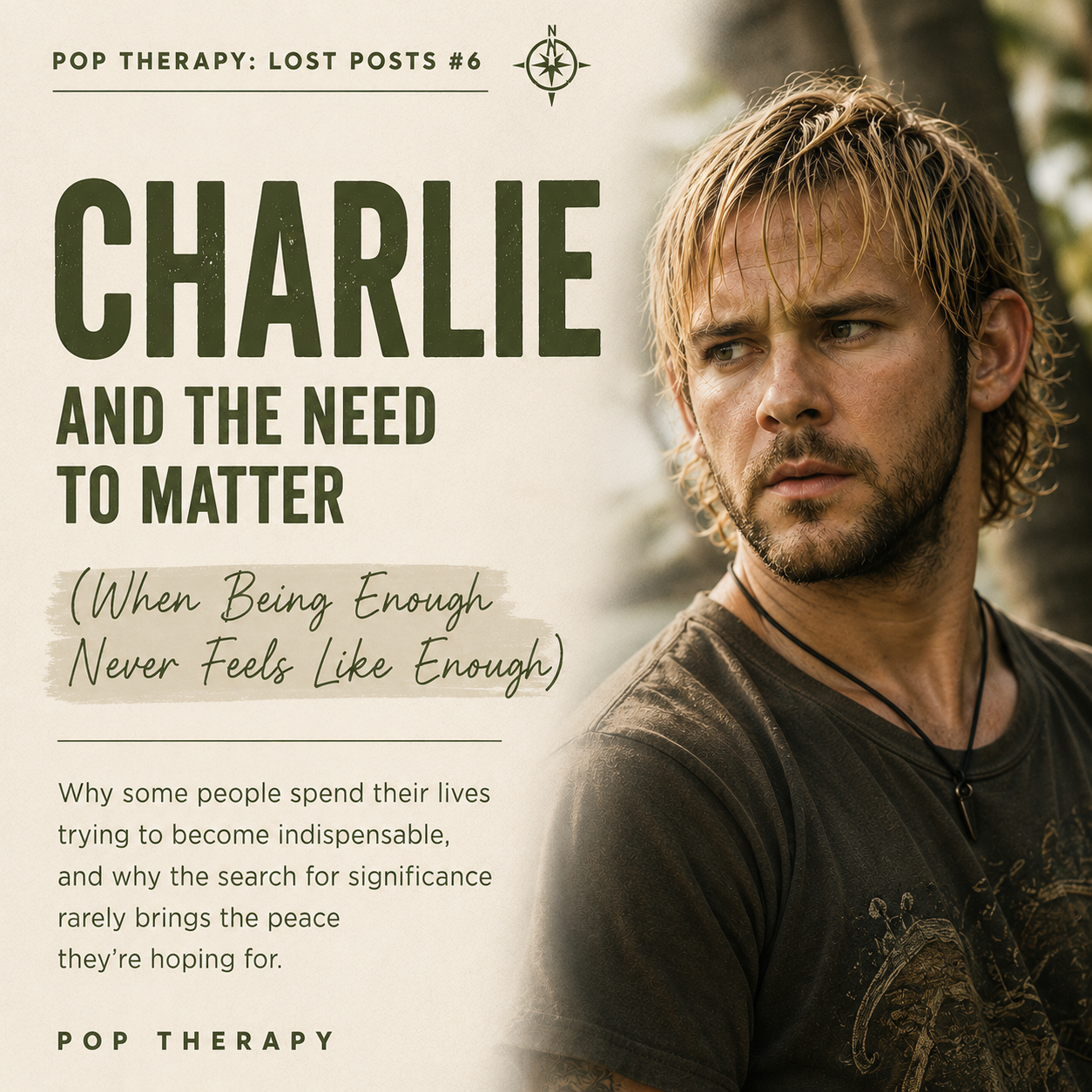
One of the reasons Charlie Pace remains such a memorable character is that his struggle was never really about heroin.
The heroin was real.
The addiction was real.
But underneath both was a question that many people quietly carry:
"Do I matter?"
Long before Oceanic 815 crashed on the island, Charlie was living in the shadow of a story he couldn't escape.
He wasn't the famous one.
He wasn't the successful one.
He wasn't the one people remembered.
His band had become a joke. His career had collapsed. The life he imagined for himself seemed to be slipping away.
Everywhere he looked, there was evidence that he was becoming forgettable.
For Charlie, drugs became a way to manage the pain of that story.
Not because they solved anything.
Because they briefly allowed him to stop feeling it.
Many people think addiction begins with pleasure.
Often it begins with relief.
Relief from shame.
Relief from loneliness.
Relief from the fear that something is fundamentally wrong with you.
The substance changes from person to person.
Alcohol.
Work.
Achievement.
Relationships.
Approval.
Scrolling.
Distraction.
But the question underneath often sounds familiar:
"How do I stop feeling like I am not enough?"
The tragedy is that the harder we try to escape that feeling, the more power it gains.
Charlie spends much of Lost trying to prove his worth.
He wants Claire to trust him.
He wants the survivors to respect him.
He wants to be seen as reliable.
Important.
Necessary.
But every attempt to force significance seems to create more suffering.
This is a pattern many people know well.
When we feel insignificant, we often try to earn our value.
We become helpful.
Productive.
Funny.
Successful.
Indispensable.
We work harder and harder to secure proof that we matter.
The problem is that proof never lasts very long.
Soon we need more.
And more.
And more.
The island slowly forces Charlie to confront something difficult:
Maybe worth cannot be earned.
Maybe it has to be accepted.
One of the most powerful moments in Charlie's story comes near the end of his journey.
Not because he becomes famous again.
Not because he finally gets everything he wants.
But because he stops organizing his life around proving himself.
For perhaps the first time, Charlie acts from love rather than from insecurity.
He is no longer asking:
"Will this make me matter?"
He is asking:
"What matters?"
That is a very different question.
Many of us spend years trying to become enough.
Trying to become important enough.
Successful enough.
Desired enough.
Needed enough.
Charlie's story suggests a different possibility.
The answer may not be found in becoming more.
The answer may be found in loosening our grip on the belief that we were ever less.
Pop Therapy Takeaway
When people feel insignificant, they often try to become indispensable.
But the need to matter can become a prison.
The goal is not to prove your worth.
The goal is to stop building your life around the fear that you have none.