Sayid and the Weight of What You’ve Done
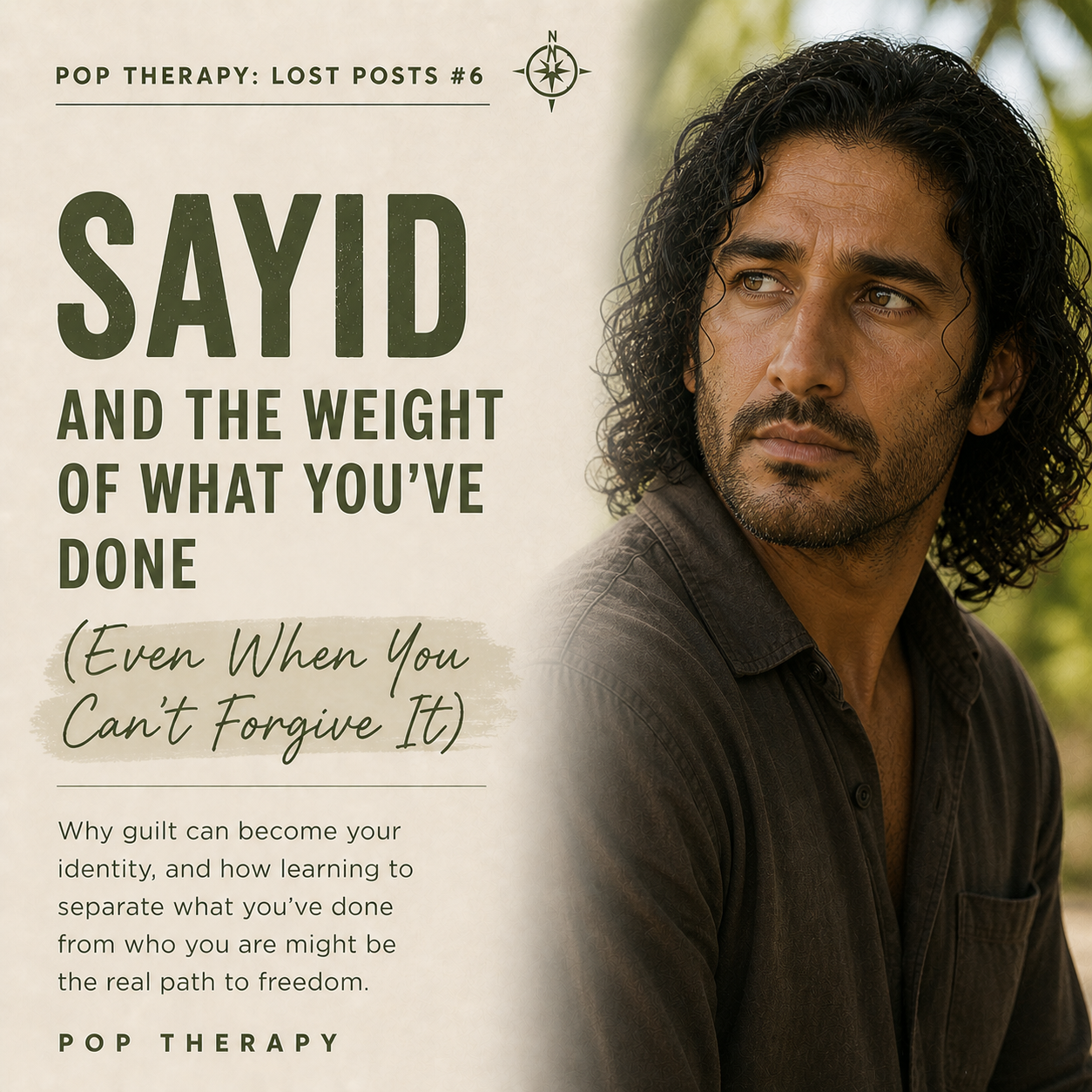
If you’ve watched Lost, you know Sayid Jarrah carries something heavier than most.
Not just what happened to him.
What he’s done.
And more than that—
What he believes it means about who he is.
The Pattern Beneath the Guilt
Sayid doesn’t just remember his past.
He organizes his identity around it.
I’ve done terrible things → therefore I am a terrible person.
It’s clean. It’s certain.
And it leaves very little room for anything else.
What This Looks Like in Real Life
This pattern doesn’t always show up as obvious guilt.
Sometimes it looks like:
holding yourself to a harsher standard than anyone else
feeling like you don’t deserve good things
sabotaging relationships when they start to feel real
staying stuck in the role of “the one who messed things up”
trying to make up for the past in ways that never feel like enough
You don’t move on—not because you can’t—
But because something in you believes you shouldn’t.
Why the Past Stays So Present
For people like Sayid, guilt becomes a kind of anchor.
It does a few things at once:
creates a sense of moral order (bad things should have consequences)
prevents forgetting (I won’t let myself off the hook)
keeps control (if I stay aware of it, I won’t repeat it)
Letting go of guilt can feel dangerous.
Like it might mean you didn’t care.
Or worse—that you’d do it again.
The Problem with Living There
Guilt can point to something important.
But when it becomes your identity, it stops helping.
It turns into:
self-punishment
emotional isolation
a quiet refusal to let anything good fully land
And over time, it creates a closed loop:
I’ve done bad things → I am bad → I don’t deserve good → I stay stuck → which proves I’m bad.
Sayid and the Search for Redemption
Sayid doesn’t ignore what he’s done.
He tries to balance it.
Protecting others. Taking on difficult roles. Doing what needs to be done.
A lot of people do this:
over-functioning
being the responsible one
trying to “earn” their place in relationships
But no amount of doing seems to erase the past.
Because the real question underneath isn’t:
Have I done enough?
It’s:
Am I allowed to be more than what I’ve done?
What’s Actually Underneath
This isn’t just about guilt.
It’s about identity.
At some point, the story locked in:
This is who I am now.
And anything that challenges that story can feel disorienting.
Even hopeful things.
The Shift: Separating What You Did from Who You Are
This is the hard work.
Not denying the past.
Not minimizing it.
But loosening the fusion between action and identity.
That might look like:
naming what you did without turning it into a global judgment
allowing complexity (I’ve caused harm AND I’m capable of care)
noticing when you’re replaying the same internal verdict
letting someone see a part of you that isn’t defined by the past
Slowly.
Carefully.
A Simple Check-In
When the past shows up, ask:
What am I telling myself this says about me?
Is that the only possible interpretation?
If someone I cared about had done this, would I define them the same way?
You don’t have to rewrite the whole story.
Just create a little space around it.
Sayid, Revisited
Sayid’s story isn’t about whether he’s “good” or “bad.”
It’s about whether he can live with the truth of what he’s done—
Without letting it be the only truth.
And on the island, you see moments where that shift almost happens.
Where connection, care, and choice start to complicate the story.
If This One Feels Familiar
You don’t have to pretend the past didn’t happen.
But you also don’t have to live your entire life inside of it.
You can hold responsibility—
Without turning it into a life sentence.
That’s where something new starts.
Next in the Pop Therapy series: Sun and Jin—the distance that forms when love and resentment grow at the same time.