Desmond Hume and the Problem of Living in the Future
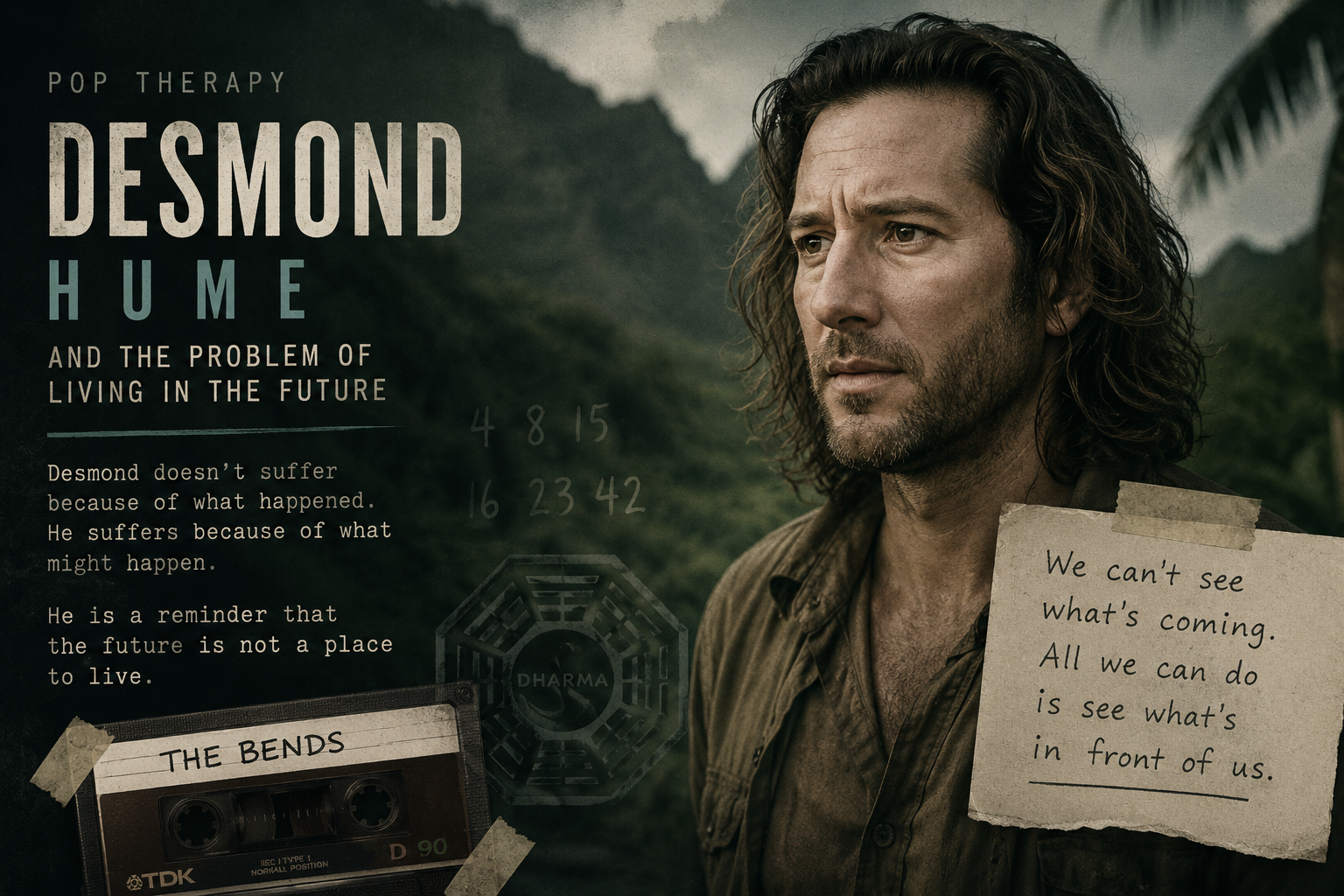
There is a particular kind of suffering that doesn't come from the past. Most of us are familiar with old wounds, old losses, old humiliations. We know what it is like to replay an embarrassing moment from ten years ago while standing in the shower. We know what it is like to have a conversation with someone who isn't even in the room anymore. But Desmond Hume reminds us that people can become trapped by the future just as easily as they can become trapped by the past.
When we first meet Desmond on Lost, he seems like an odd side character. He lives alone in a bunker. He enters numbers into a computer every 108 minutes. He carries a weapon. Mama Cass plays on his turntable. He looks exhausted. He seems to be carrying around some enormous burden that nobody else can quite understand. As it turns out, we learn that his burden is not really the button or the island - it’s the belief that catastrophe is always just around the corner and that it is his responsibility to stop it. No pressure.
Many people who come to therapy know this feeling intimately…
They may not be preventing electromagnetic disasters, but they are scanning constantly for the next thing that could go wrong. They rehearse conversations before they happen. They imagine worst-case scenarios. They build elaborate mental maps of possible futures. They become convinced that if they think hard enough, prepare carefully enough, or worry intensely enough, they can somehow gain control over what comes next. That happens to be what depression looks like - trying to think your way out of an emotional problem. Trust me, the square peg is never going to fit.
The trap, of course, is that the mind begins treating imagined futures as if they are already real.
I often think anxiety gets described incorrectly. People talk about fear as though it is simply fear. More often, anxiety feels like responsibility. The anxious person is rarely sitting around thinking, "I am scared." Instead, they are thinking, "I need to figure this out." They are trying to solve a problem that hasn't happened yet. They are attempting to manage outcomes that do not yet exist. They become project managers for futures that may never arrive.
Desmond lives almost entirely in this state - never quite in the present moment.
After his flashes through time begin, he becomes obsessed with changing outcomes. He sees Charlie die. Then he sees it again. And again. Each time, he intervenes. Each time, he postpones the inevitable. His efforts are understandable. They are compassionate. They are also exhausting. Desmond becomes trapped in a cycle familiar to many anxious people: the belief that vigilance is the only thing standing between order and catastrophe.
At first, this feels empowering - if the future depends on me, then I matter.
If I can prevent disaster, then I have purpose.
If I stop worrying, something terrible might happen.
This bargain works for a while. Then it starts charging interest.
What began as concern becomes hypervigilance. What began as preparation becomes obsession. Life shrinks. Relationships become secondary. The present moment becomes little more than a staging area for future emergencies.
I think this is why Desmond's relationship with Penny matters so much.
Penny is not simply a love interest. She represents something much larger. Throughout the series, she functions almost like an anchor to reality itself. When Desmond is pulled across timelines, consciousness, memories, and possible futures, it is Penny who helps him find his way back. Not because she has all the answers, but because she connects him to something that exists right now.
The older I get, the more I think healing often involves finding our own version of Penny.
Not necessarily a person. Sometimes it is a relationship. Sometimes it is a creative practice. Sometimes it is a garden, a community, a spiritual tradition, or even a daily walk through the neighborhood. Something that keeps pulling us back to the life that is actually happening instead of the life we are trying to predict.
The challenge is that many of us secretly believe our worrying is helping. We treat anxiety like an unpaid intern who works around the clock. Sure, it is annoying, but maybe it is getting something done. Maybe all that forecasting and preparation is keeping disaster at bay.
Yet when you listen carefully, most anxious people are not enjoying the benefits of certainty. They are enduring the costs of uncertainty while convincing themselves they are gaining control.
Desmond eventually learns something many therapy clients struggle to learn: there is no finish line where uncertainty disappears. There is no final prediction that makes the future safe. There is no perfect amount of preparation that guarantees nothing painful will happen.
Life remains uncertain.
People leave and relationships change.
Dreams fail and bodies age.
Plans simply collapse…
And somehow, despite all of that, people continue.
That may be the most radical idea in all of Lost. Not that destiny exists. Not that everything happens for a reason. Not even that time can be changed. The radical idea is that human beings can survive uncertainty without conquering it.
Desmond spends much of the series trying to control what comes next. The moments that feel most meaningful are the ones when he finally reconnects with what is already here.
Maybe that is the invitation his story offers the rest of us - not to stop caring about the future.
Not to stop planning and hoping.
Just to notice when we have wandered so far into the future or past timelines that we have forgotten to live in the present.
Somewhere in the mid-1990s, while some kid listened to The Bends for the hundredth time, someone probably had the same realization: no amount of thinking can cure emotional numbness or substitute for being alive. The future eventually arrives on its own schedule. In the meantime, there is a life happening right here, messed up and unfinished, waiting for our attention.
Interested in booking a therapy session with me?
I recorded a short reflection in my office about why Desmond's story continues to resonate and what it might teach us about waiting for our lives to begin.
Desmond Hume spent years waiting for his life to begin.
Waiting for the right time. The right answer. The right sign that it was finally okay to move forward.
In therapy, I often meet people who feel similarly stuck—living in the future, replaying the past, or waiting for certainty before taking the next step.
A few thoughts on what Desmond's story from Lost might have to teach us about time, fear, and the lives we keep postponing.
Read the full Pop Therapy article at https://www.menstherapykansascity.com.
#Lost #DesmondHume #PopTherapy #MensTherapy #KansasCityTherapist