What Lost Taught Me About Therapy
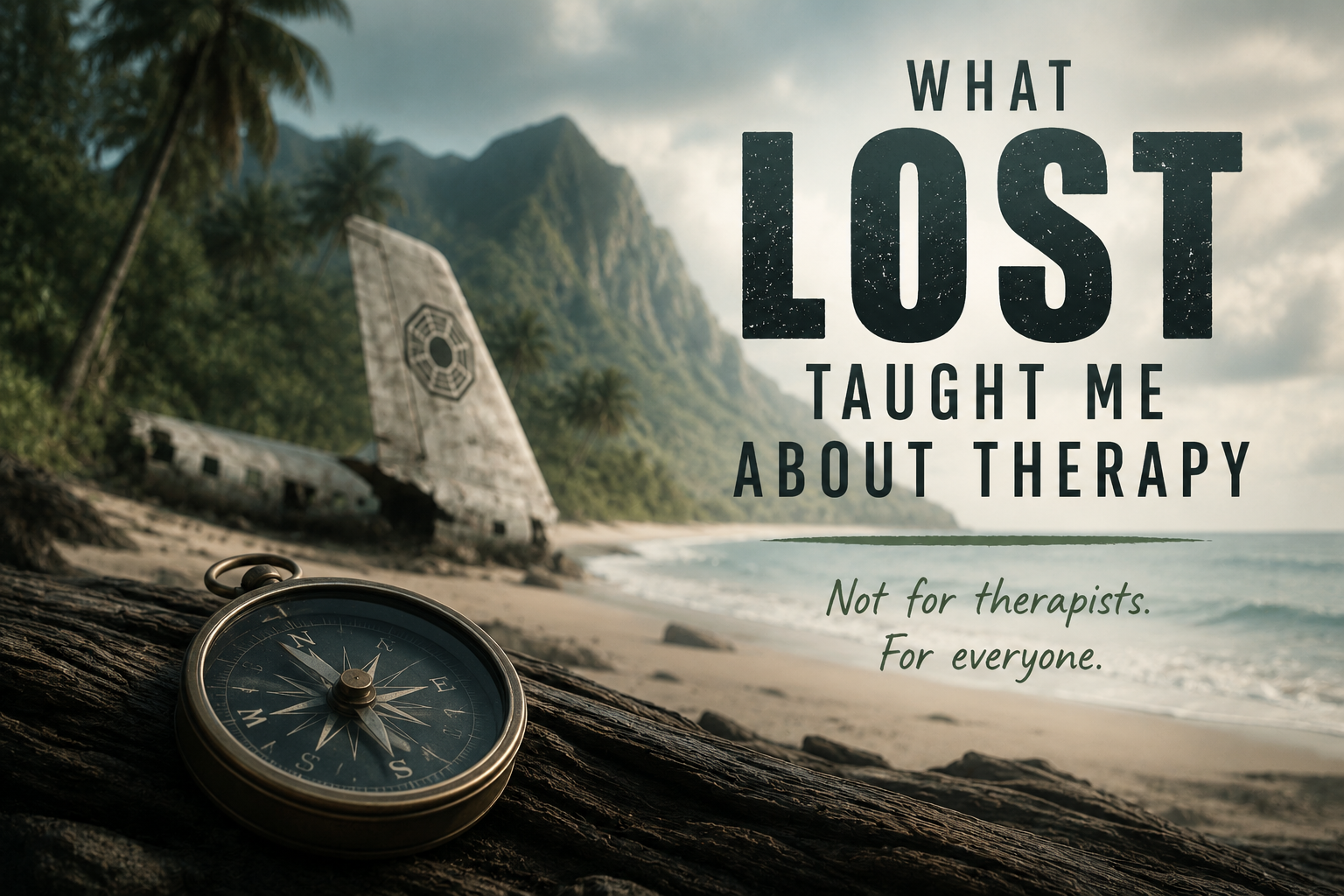
Years ago, when I first watched Lost, I thought it was a show about survival. A plane crashes on a mysterious island, strangers are forced to work together, and everyone is trying to figure out how to get home. Like millions of other viewers, I spent years obsessing over the mysteries. What was the smoke monster? What was the hatch? What was really going on?
Then I became a therapist.
Somewhere along the way, I realized that Lost was never actually about the island. It was about time.
Every character arrived carrying a past that refused to stay dead. The show used flashbacks to reveal old wounds, unfinished business, regrets, and betrayals. The island might have been the stage, but the real struggle was happening inside the characters, who were constantly reacting to ghosts from years before.
What struck me later was how profoundly familiar that felt.
Most people who come into my practice aren't just struggling with what is happening today. They are struggling with today’s situation plus every historical version of that situation that came before it. A disagreement with a spouse isn't just a disagreement with a spouse; it carries the heavy echoes of a critical parent, an absent partner, or a humiliating experience from childhood. The past rarely stays politely in the past.
At the same time, many of us are living somewhere else entirely: the unwritten future. We rehearse divorces before the conversation even begins. We anticipate the rejection before dialing the number. We mourn the failure before taking the chance. By creating entire emotional realities based on events that exist only in our imagination, the future starts exerting influence long before it arrives.
What fascinated me about Lost was that while the characters were constantly being pulled backward and forward through time, the island was the only place they could actually do anything. The island was where choices were made, where relationships were forged, and where healing occurred.
Therapy works the exact same way.
A large part of my job is helping people recognize when they have wandered into an emotional flashback without realizing it—a moment when an old story suddenly feels more real than the room they are sitting in. Another part of the work is noticing when someone has become trapped in a flashforward. They are no longer responding to the present; they are bracing for a catastrophe they’ve already decided is inevitable.
What therapy offers, at its best, is a return to the island.
Not because the past and future don't matter—they do. But because the present is the only arena where anything can actually change.
Over the years, this metaphor became the foundation for a framework I call Temporal Narrative Therapy. The premise is simple: before we can change a pattern, we have to know where we are standing in time.
Are we reacting to something that happened a decade ago?
Are we bracing for something that hasn't happened yet?
Or are we actually responding to what is right in front of us?
I still think about Lost from time to time. Not because I need answers to the mysteries anymore—most of those stopped mattering. What stayed with me were the characters. They were just people carrying old stories, fearing uncertain futures, and trying to build a life in the middle of it all.
Which, when you think about it, is pretty much all of us.
Beneath the polar bears, smoke monsters, and endless fan theories, the show understood a fundamental human truth: the hardest place to stay is the present. And it is also the only place where we can finally heal.
If this idea resonates with you, you can learn more about my approach, Temporal Narrative Therapy, here.