
Sayid and the Weight of What You’ve Done
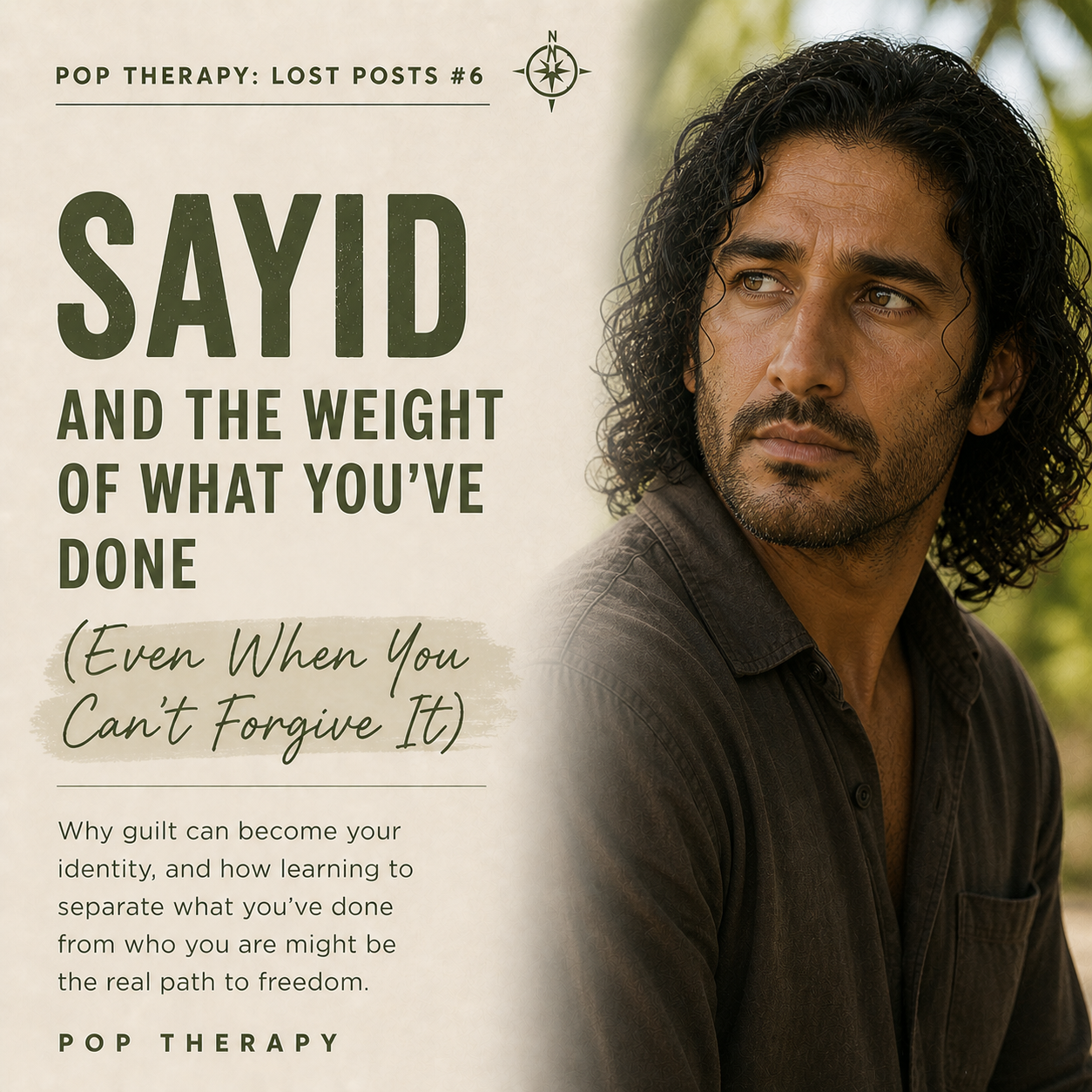
If you’ve watched Lost, you know Sayid Jarrah carries something heavier than most.
Not just what happened to him.
What he’s done.
And more than that—
What he believes it means about who he is.
The Pattern Beneath the Guilt
Sayid doesn’t just remember his past.
He organizes his identity around it.
I’ve done terrible things → therefore I am a terrible person.
It’s clean. It’s certain.
And it leaves very little room for anything else.
What This Looks Like in Real Life
This pattern doesn’t always show up as obvious guilt.
Sometimes it looks like:
holding yourself to a harsher standard than anyone else
feeling like you don’t deserve good things
sabotaging relationships when they start to feel real
staying stuck in the role of “the one who messed things up”
trying to make up for the past in ways that never feel like enough
You don’t move on—not because you can’t—
But because something in you believes you shouldn’t.
Why the Past Stays So Present
For people like Sayid, guilt becomes a kind of anchor.
It does a few things at once:
creates a sense of moral order (bad things should have consequences)
prevents forgetting (I won’t let myself off the hook)
keeps control (if I stay aware of it, I won’t repeat it)
Letting go of guilt can feel dangerous.
Like it might mean you didn’t care.
Or worse—that you’d do it again.
The Problem with Living There
Guilt can point to something important.
But when it becomes your identity, it stops helping.
It turns into:
self-punishment
emotional isolation
a quiet refusal to let anything good fully land
And over time, it creates a closed loop:
I’ve done bad things → I am bad → I don’t deserve good → I stay stuck → which proves I’m bad.
Sayid and the Search for Redemption
Sayid doesn’t ignore what he’s done.
He tries to balance it.
Protecting others. Taking on difficult roles. Doing what needs to be done.
A lot of people do this:
over-functioning
being the responsible one
trying to “earn” their place in relationships
But no amount of doing seems to erase the past.
Because the real question underneath isn’t:
Have I done enough?
It’s:
Am I allowed to be more than what I’ve done?
What’s Actually Underneath
This isn’t just about guilt.
It’s about identity.
At some point, the story locked in:
This is who I am now.
And anything that challenges that story can feel disorienting.
Even hopeful things.
The Shift: Separating What You Did from Who You Are
This is the hard work.
Not denying the past.
Not minimizing it.
But loosening the fusion between action and identity.
That might look like:
naming what you did without turning it into a global judgment
allowing complexity (I’ve caused harm AND I’m capable of care)
noticing when you’re replaying the same internal verdict
letting someone see a part of you that isn’t defined by the past
Slowly.
Carefully.
A Simple Check-In
When the past shows up, ask:
What am I telling myself this says about me?
Is that the only possible interpretation?
If someone I cared about had done this, would I define them the same way?
You don’t have to rewrite the whole story.
Just create a little space around it.
Sayid, Revisited
Sayid’s story isn’t about whether he’s “good” or “bad.”
It’s about whether he can live with the truth of what he’s done—
Without letting it be the only truth.
And on the island, you see moments where that shift almost happens.
Where connection, care, and choice start to complicate the story.
If This One Feels Familiar
You don’t have to pretend the past didn’t happen.
But you also don’t have to live your entire life inside of it.
You can hold responsibility—
Without turning it into a life sentence.
That’s where something new starts.
Next in the Pop Therapy series: Sun and Jin—the distance that forms when love and resentment grow at the same time.
Desmond Hume and the Life You Keep Postponing
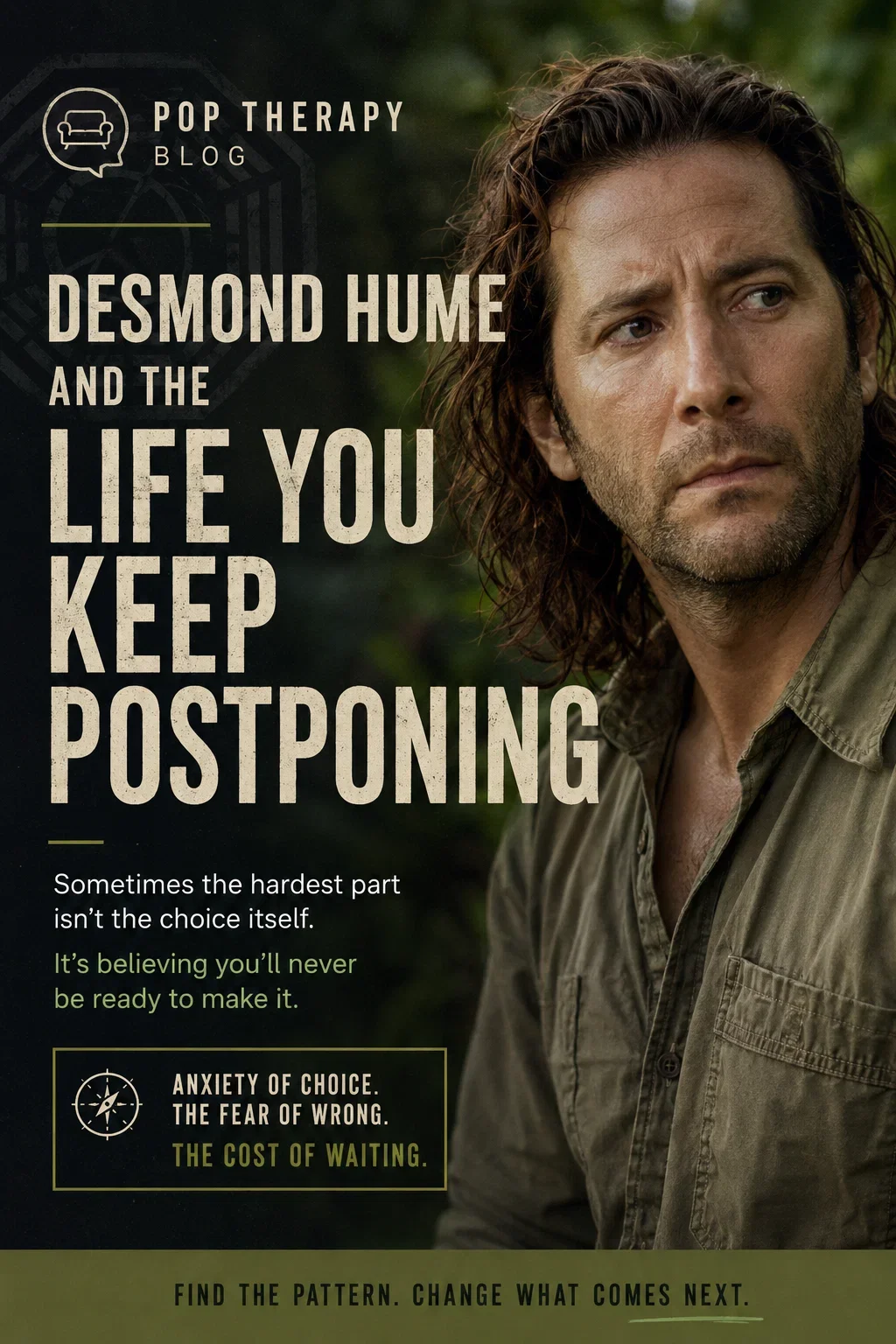
Desmond spent most of Lost trying to outrun a decision.
Not just a bad decision.
A final one.
He wanted certainty before committing to a path. Before loving fully. Before trusting himself. Before becoming the kind of man he hoped he could be.
So he drifted.
From the monastery.
To the military.
To the Island.
To the hatch.
Always moving. Always searching for the thing that would finally make him feel ready.
A lot of people live like that.
They tell themselves they’re “thinking it through.”
“Waiting until things calm down.”
“Trying to make the right choice.”
But underneath it is often fear.
Fear that one wrong move could collapse the entire future.
So instead of choosing, they hover.
They overthink relationships.
Stay stuck in jobs they hate.
Wait to feel confident before taking action.
Keep searching for some sign that guarantees safety.
But life usually doesn’t work like that.
Desmond’s whole story is about realizing that certainty is never coming.
At some point, you stop trying to predict every possible future and start participating in the one that’s actually happening.
That’s the shift.
Not becoming fearless.
Not suddenly becoming “sure.”
Just becoming willing.
Willing to risk disappointment.
Willing to stop rehearsing life and actually enter it.
A lot of anxiety comes from trying to solve the future before you live the present.
But the future is shaped by movement, not endless calculation.
That’s something I see often in therapy with men especially.
The feeling that life is somehow waiting to begin once they finally “figure themselves out.”
Meanwhile years pass.
Relationships drift.
Creativity shrinks.
The world gets smaller.
The Island in Lost had a way of forcing people into the present.
No more endless escape routes.
No more pretending there would always be another timeline later.
Eventually the question becomes:
What would your life look like if you stopped waiting to feel completely ready?
And what small move would count as beginning now?
If this pattern feels familiar, you may also want to read more about Temporal Narrative Therapy and how old timelines can keep people emotionally stuck in the present.
Find the pattern. Change what comes next.
Hurley and the Fear That It Will All Fall Apart
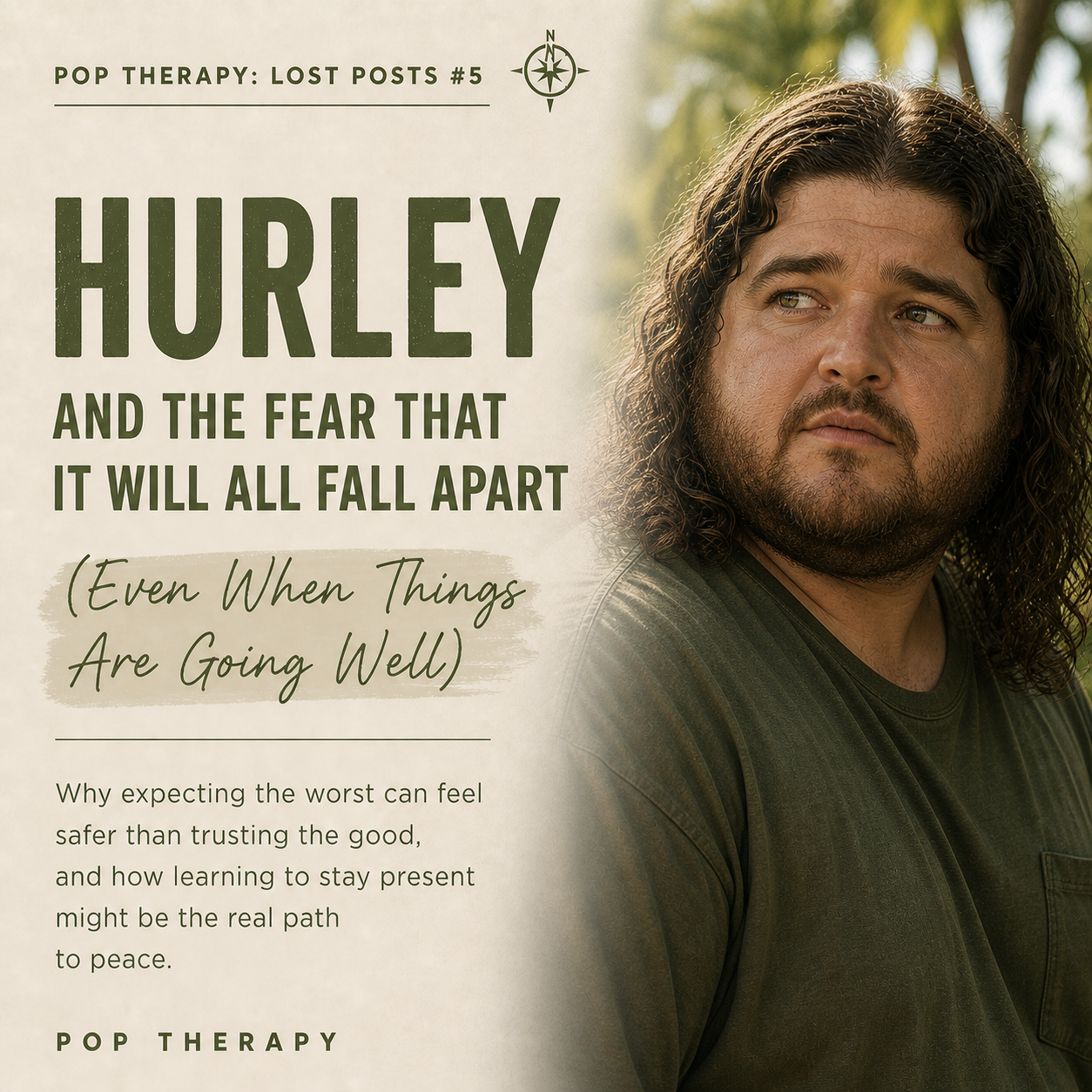
If you’ve watched Lost, you know Hugo "Hurley" Reyes isn’t just the comic relief.
He’s the one who’s waiting for the other shoe to drop.
Even when things are going well.
Especially then.
The Pattern Beneath the Anxiety
Hurley doesn’t trust good things to last.
Not because he’s negative.
Because his experience has taught him:
If something feels good, it probably won’t stay that way.
So even in moments of connection, success, or calm…
There’s a quiet tension underneath it:
When is this going to go wrong?
What did I miss?
What’s about to fall apart?
That tension doesn’t shut off just because life improves.
What This Looks Like in Real Life
This pattern shows up in ways that don’t always look like anxiety at first:
You finally get something you wanted… and can’t enjoy it
You scan for problems even when nothing is wrong
You feel responsible for preventing things from going bad
You brace yourself during good moments instead of relaxing into them
You think: “Don’t get too comfortable”
From the outside, it can look like overthinking.
From the inside, it feels like staying prepared.
Why “Good” Can Feel So Unstable
For some people, unpredictability wasn’t the exception growing up.
It was the baseline.
So the nervous system learns:
Good moments are temporary
Stability is fragile
If you relax, you’ll get blindsided
Which leads to a hard-to-see loop:
You don’t trust good things →
You stay tense →
You never fully experience them →
Which reinforces the idea that something is off
Hurley and the Need to Make Sense of It All
Hurley tries to solve the feeling by explaining it.
The numbers. The curse. The meaning behind everything.
If he can just figure it out, maybe he can control it.
A lot of people do this in quieter ways:
trying to “figure out” why things are going well
looking for hidden problems
assuming there must be a catch
Because if there’s a reason, maybe there’s a way to stay safe.
What’s Actually Underneath
This isn’t really about pessimism.
It’s about protection.
At some point, being caught off guard hurt.
So now your system says:
Stay ready. Don’t relax too much. Don’t trust it fully.
The problem is, that same protection keeps you from feeling what you actually want:
ease
enjoyment
connection that lands
The Shift: Letting Good Things Be Good
This isn’t about “thinking positive.”
It’s about building tolerance for something unfamiliar:
things going well.
That might look like:
noticing when something is good without immediately analyzing it
catching the urge to scan for problems
letting a moment land before questioning it
saying (even quietly): “Nothing is wrong right now.”
Not forever.
Just right now.
A Simple Check-In
Next time something good is happening, pause and ask:
What am I expecting to go wrong?
Do I have evidence for that right now?
Can I let this moment be what it is, just for a few seconds?
You don’t have to convince yourself everything will be fine.
Just notice what your system is doing.
Hurley, Revisited
Hurley’s story isn’t about being “unlucky.”
It’s about someone trying to feel safe in a world that hasn’t always made sense.
And slowly—on the island—he starts to do something different.
He stays.
He connects.
He lets moments matter, even without guarantees.
If This One Feels Familiar
You’re not broken if you struggle to enjoy good things.
You may have just learned that good things don’t last.
That’s a pattern.
And patterns can shift.
Not all at once.
But enough to start feeling your life as it’s actually happening—not just bracing for what might come next.
Next in the Pop Therapy series: Sayid and the weight of what you’ve done—and what you believe it says about you.
Kate Austen and the Pattern of Running (Even When You Want to Stay)

If you’ve watched Lost, you know Kate Austen doesn’t just run.
She needs to run.
Not because she’s careless.
Not because she doesn’t care about people.
But because staying—really staying—brings up something harder.
The Pattern Beneath the Running
Kate’s story isn’t just about being “on the run” from the law.
It’s about being on the run from:
being fully known
being depended on
being seen clearly by someone who matters
Every time things get real—emotionally real—something in her system says:
This is where it gets dangerous.
So she moves. Changes direction. Shifts relationships. Keeps just enough distance.
From the outside, it can look like inconsistency.
From the inside, it feels like survival.
What This Looks Like in Real Life
You don’t have to be on a tropical island to recognize this pattern.
It shows up more quietly:
You get close to someone… then start pulling back for no clear reason
You say you want commitment, but feel restless when things stabilize
You replay “what if” scenarios about other paths, other people
You feel more alive in uncertainty than in calm connection
You leave before anyone else gets the chance to leave you
And the confusing part?
You do want connection.
You’re not faking that.
Why Stability Can Feel So Unsettling
For people like Kate, chaos feels familiar.
And familiarity often registers as safe, even when it isn’t.
Calm, steady connection?
That can feel:
boring
suspicious
like something is about to go wrong
So the system does what it knows how to do.
It creates movement.
The Triangle: Jack, Sawyer, and the Pull of Opposites
Kate is pulled between Jack Shephard and James 'Sawyer' Ford for a reason.
Jack represents stability, structure, a kind of grounded presence.
Sawyer represents intensity, unpredictability, emotional charge.
She doesn’t just “choose wrong.”
She gets caught between two internal pulls:
the part that wants something solid
the part that feels more alive in the push-pull
A lot of people live right in that tension.
What’s Actually Happening Underneath
Running is rarely about the situation in front of you.
It’s usually tied to something older:
trust that didn’t hold
closeness that felt unsafe
needing to rely on yourself too early
At some point, moving became the safest option.
And your system learned:
Don’t stay long enough to get hurt.
The problem is, that same strategy blocks the very thing you want now.
The Hard Shift: Learning to Stay
The work isn’t forcing yourself into a relationship.
It’s learning how to stay present when your system wants to leave.
That might look like:
noticing the urge to pull away without immediately acting on it
naming what’s happening instead of disappearing
tolerating a little more steadiness than you’re used to
letting someone see you in a moment you’d normally hide
Not perfectly.
Just a little more than before.
A Simple Check-In
When you feel the urge to create distance, ask:
What just got activated in me?
What feels risky about staying right now?
Am I reacting to this moment… or something older?
You don’t have to solve it.
Just slow it down.
Kate, Revisited
Kate’s story isn’t about being broken.
It’s about a nervous system that learned to survive by moving.
But on the island—when she’s forced to stop—something different becomes possible.
Not easy.
Not clean.
But real.
If This One Hits Close to Home
You’re not alone in this pattern.
A lot of people who struggle with “commitment” aren’t afraid of commitment.
They’re navigating what happens inside them when things start to matter.
That’s where the work is.
And it’s work you can actually do.
Next in the Pop Therapy series: Hurley and the fear that things will fall apart even when they’re going well.
Locke and the Need to Believe in Something
The need to believe in something can bring clarity—or close things off too quickly. This is how that pattern works.
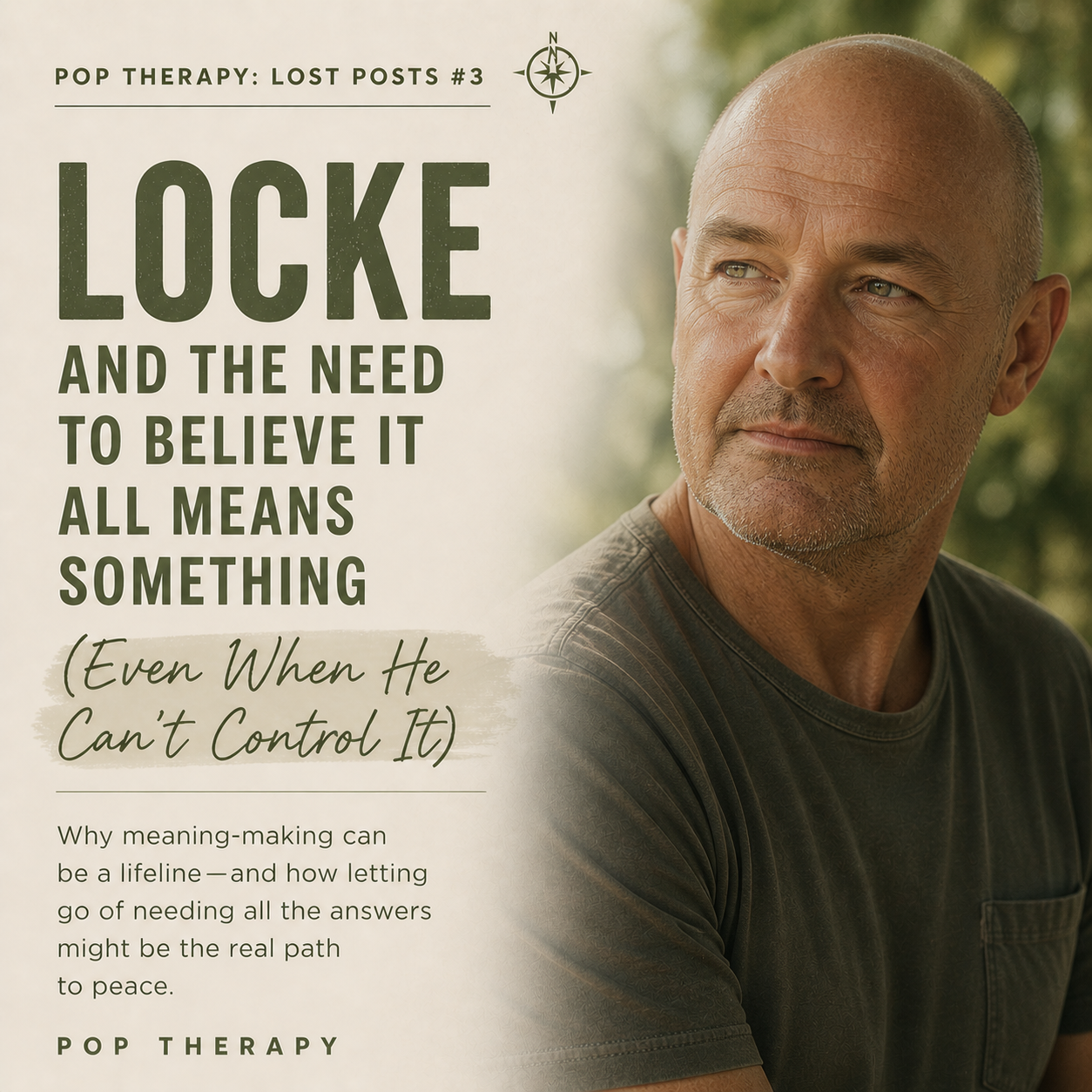
Locke doesn’t hesitate.
Where others question, he commits.
Where things don’t make sense, he finds meaning.
Not randomly.
Not carelessly.
Deliberately.
He believes there’s something larger happening.
Something that explains all of it.
And once he locks into that, he moves with certainty.
The Pattern
There’s a version of this that shows up in real life.
You don’t stay in uncertainty for long.
You look for:
meaning
direction
something to hold onto
And when you find it, it clicks.
Things feel clearer.
More organized.
More certain.
It’s not about being naïve.
It’s about not wanting to feel lost.
What’s Actually Driving It
This isn’t really about belief.
It’s about uncertainty.
There’s usually a moment—subtle but uncomfortable—where something feels unclear:
what this means
what direction to go
whether something matters
And instead of staying there, you move toward meaning.
You find a framework.
A story.
A belief that organizes everything.
And the discomfort drops.
Why It Works (and Why It Doesn’t)
This pattern works because it creates:
clarity
purpose
direction
You feel:
grounded
certain
like you’re moving forward
But over time:
nuance gets lost
conflicting information gets ignored
you can become rigid without realizing it
Not because you’re trying to be.
Because the alternative feels too uncertain.
How This Shows Up in Relationships
This is where it becomes more visible.
You:
interpret situations quickly
assign meaning to behavior
feel confident about what’s happening
But the other person may feel:
misunderstood
simplified
like there isn’t room for their perspective
And when they push back, it can feel like:
they’re disrupting something that finally makes sense
So you hold your position.
And the distance grows.
Where This Starts
At some point, uncertainty likely didn’t feel safe.
Maybe:
things were unpredictable
there wasn’t clear direction
you had to figure things out on your own
So you developed something that helped:
👉 a way to create meaning quickly
It worked.
It gave you structure.
But what helped then can quietly limit you now.
The Cost
The cost isn’t belief itself.
It’s what gets excluded.
complexity
contradiction
other perspectives
your own doubt
And over time:
You can feel certain…
but also disconnected from what’s actually happening.
The Shift
This isn’t about giving up belief.
That’s not the goal.
The shift is smaller.
It happens in the moment when something doesn’t fully fit.
Instead of resolving it immediately, you pause.
And ask:
What if I don’t have to decide what this means yet?
That question creates space.
Not chaos.
Just space.
A Different Way of Holding Meaning
There’s a version of this that evolves.
You still care about meaning.
You still look for direction.
But you also:
leave room for uncertainty
allow multiple possibilities
stay open a little longer
It doesn’t make you less grounded.
It makes you more flexible.
Back to Locke
Locke isn’t wrong for wanting meaning.
It gives him direction.
It gives him purpose.
But the same certainty that helps him move forward
can also keep him from seeing what doesn’t fit.
That’s the tradeoff.
Where This Leaves You
If this feels familiar, there’s nothing to fix.
This pattern likely helped you make sense of things when it mattered.
But it might also be shaping how you interpret your life now.
This week, notice one moment when something feels unclear.
Instead of resolving it immediately, pause.
Just long enough to stay with the uncertainty.
That’s where something new can happen.
Touch Base
If this pattern shows up in your life and you want to work through it more directly:
Sawyer and the Joke That Covers Everything
Humor can keep things light—but it can also keep people at a distance. A look at the pattern behind it.
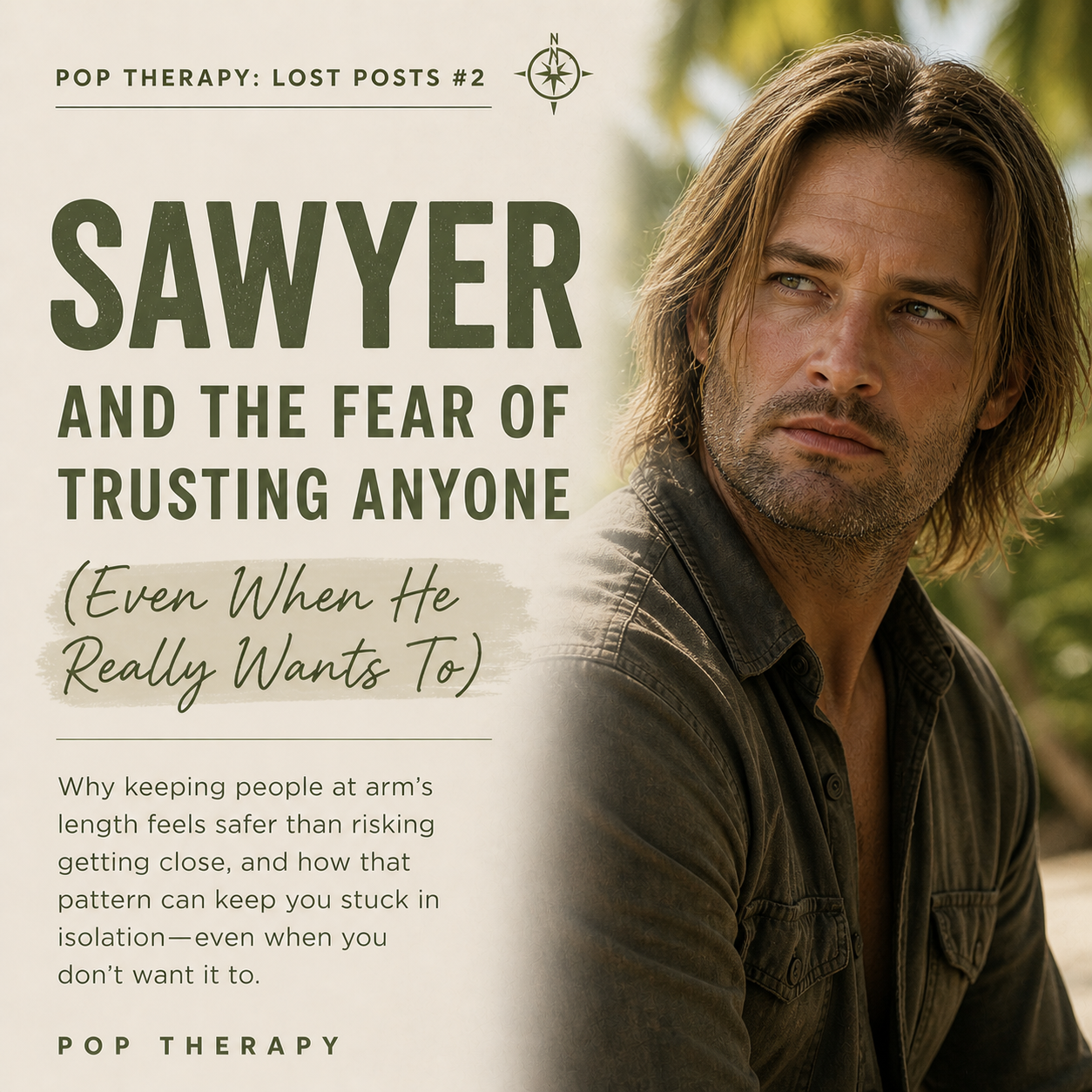
Sawyer doesn’t miss.
Someone says something real—
he cuts it down.
Something gets close—
he turns it into a joke.
It lands.
People laugh.
And just like that, the moment passes.
The Pattern
There’s a version of this that shows up all the time.
You stay quick.
You stay sharp.
You keep things moving.
If something gets too real:
you joke
you deflect
you shift the focus
It works.
It keeps things light.
It keeps people engaged.
It keeps you from getting stuck in something uncomfortable.
But it also keeps something else from happening.
What’s Actually Driving It
This isn’t really about humor.
It’s about protection.
There’s usually a moment—brief, easy to miss—where something shows up:
embarrassment
vulnerability
a feeling of being exposed
And instead of staying there, you move.
You say something funny.
You change the tone.
You take control of the moment.
The feeling disappears.
At least for now.
Why It Works (and Why It Doesn’t)
This pattern gets reinforced because it works socially.
You become:
likable
entertaining
easy to be around
People respond to you.
But over time:
conversations stay surface-level
people don’t really get to know you
you start to feel a kind of distance you can’t quite explain
Not because you’re doing anything wrong.
Because the moment where something real could land… never quite does.
How This Shows Up in Relationships
This is where it becomes more noticeable.
Someone tries to get closer.
Says something honest.
Takes a small risk.
And you:
joke
redirect
lighten it
It doesn’t feel like avoidance.
It feels like keeping things comfortable.
But over time, the other person starts to feel:
like they can’t quite reach you
And you might feel:
like you’re being asked to be someone you’re not
So the distance grows—on both sides.
Where This Starts
This usually isn’t random.
At some point, humor did something important.
Maybe it:
diffused tension
helped you fit in
gave you a way to stay in control
It worked.
It made things easier.
And you got good at it.
But what worked in one environment can quietly limit you in another.
The Cost
The cost isn’t obvious at first.
It looks like:
being “fine” in most situations
being someone people enjoy
But underneath it can feel like:
not being fully known
not being taken seriously when it matters
not having a place to actually land
And over time:
A kind of isolation that doesn’t make sense on the surface.
The Shift
This isn’t about stopping humor.
That won’t work—and it’s not the goal.
The shift is smaller.
It happens in that moment right before the joke.
When something real shows up.
Instead of immediately moving away from it, you pause.
Even for a second.
And notice:
What just came up?
You don’t have to say it right away.
Just noticing it—without covering it—starts to change the pattern.
A Different Way of Showing Up
There’s a version of this that evolves.
You still have humor.
You still stay quick.
But you also:
let some moments stay real
allow a little more space
don’t rush to close everything down
It’s not about becoming serious.
It’s about becoming available.
Back to Sawyer
Sawyer isn’t wrong for how he moves.
It makes sense.
It protects him.
But it also keeps him in a certain distance from people—
even when he wants something different.
That’s the tradeoff.
Where This Leaves You
If this feels familiar, there’s nothing to fix here.
This pattern likely helped you in real ways.
But it might also be limiting how close you can actually get to people.
This week, just notice one moment.
When something real shows up—and you feel the impulse to joke.
Pause.
Just long enough to see what you’re about to move away from.
That’s where the shift starts.
Click here if you’d like to schedule a consultation for men’s counseling in Kansas City, Missouri.