
Before the Algorithm Knew Us: Gen X and the Last Shared Childhood
Before algorithms gave each of us a separate cultural world, generations grew up watching the same shows, hearing the same songs, and waiting for the same cultural moments. For Gen X, Saturday morning cartoons, reruns, MTV, magazines, and appointment television created a shared language that still brings us together.
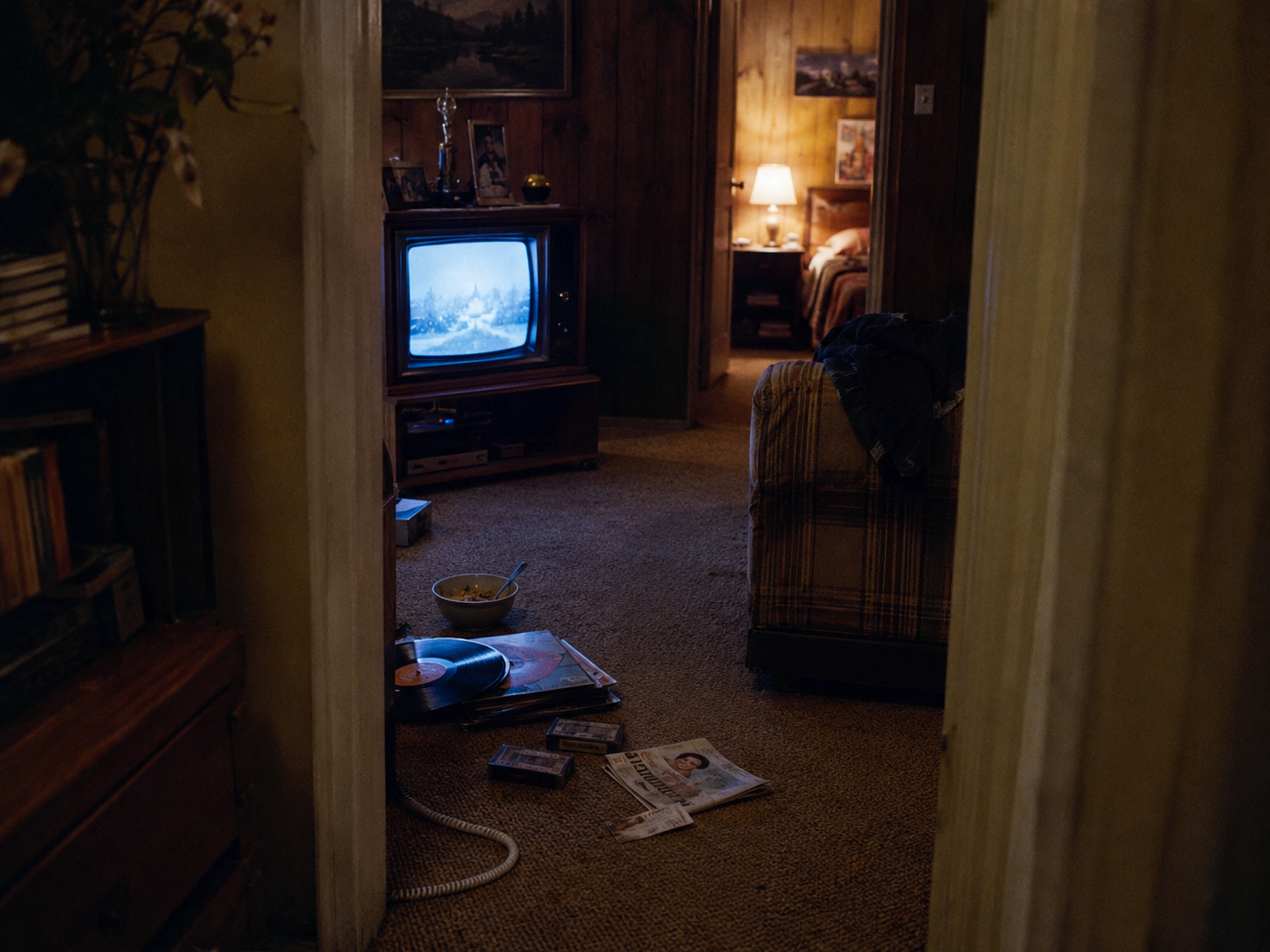
Before the internet age, popular culture did more than entertain us.
It helped organize time.
Saturday morning meant cartoons. Sunday night might mean The Wonderful World of Disney. A particular evening belonged to a particular television show. The radio sounded different at night than it did during the day. New music arrived on Tuesdays. A movie disappeared from the theater, and you had no idea when you would get another chance to see it.
Popular culture was something you waited for.
That waiting created a strange kind of power. A television show, record, magazine, or movie could become part of an entire generation’s inner life because millions of people encountered it at roughly the same time.
We were not all watching the same things. America has never been that simple. Race, geography, class, religion, gender, and family culture all shaped what entered a particular home.
But compared with today, the funnel was narrow.
There were fewer channels, fewer nationally distributed magazines, fewer ways to discover music, and almost no ability to summon exactly what you wanted at the moment you wanted it.
Because the funnel was narrow, certain things slipped through it and landed almost everywhere.
That is how The Brady Bunch became a language.
You may not have loved it. You may not even remember watching it deliberately. But say “Marcia, Marcia, Marcia” to a room full of Gen Xers and something lights up. The phrase belongs to no single person. It floats somewhere between us.
THE INVENTION OF THE TEENAGER
Popular culture did not begin in the 1950s.
Earlier generations had movies, radio serials, comic strips, jazz, swing, movie stars, pulp magazines, and fan clubs. Radio and cinema had already made it possible for people living hundreds of miles apart to hear the same voices and recognize the same faces.
What changed after World War II was the emergence of the teenager as a distinct cultural category.
Young people had always existed, of course. But the postwar teenager was increasingly treated as someone with separate music, clothing, language, desires, and money to spend. Advertisers began studying teenagers as a market. Record companies, clothing manufacturers, magazines, movies, and television programs began speaking directly to them.
Rock and roll was central to this change.
The music drew heavily from Black rhythm and blues, gospel, country, and other American traditions, but the expanding recording industry packaged it as the sound of a new youth identity. Parents often heard danger or noise. Teenagers heard a world that belonged to them.
The baby boomers became the first generation to experience modern teenage culture at an enormous national scale.
They had Elvis, James Dean, American Bandstand, transistor radios, drive-ins, and eventually the Beatles arriving on The Ed Sullivan Show. Popular culture was no longer simply something young people enjoyed. It became one of the primary ways they separated themselves from adults.
Each generation after that would have its own version.
But Gen X inherited something especially peculiar: a culture still shaped by mass broadcasting, followed by the gradual realization that the center was not going to hold.
SATURDAY MORNING WAS A PLACE
For Gen X children, Saturday morning cartoons were not merely a collection of programs.
They were a location in time.
You woke up earlier for cartoons than you would wake up for school.
You sat in front of the television with a bowl of cereal while the rest of the house remained quiet. There was no menu containing every cartoon ever made. You watched what the networks had decided children would watch that morning.
By the time Gen X came along, the Saturday morning ritual was thoroughly established.
The shows varied depending on exactly when you were born: Scooby-Doo, Super Friends, The Bugs Bunny/Road Runner Show, Fat Albert, Hong Kong Phooey, Land of the Lost, The Krofft Supershow, Schoolhouse Rock!, The Smurfs, The Jackson 5ive, Josie and the Pussycats.
The commercials were part of the experience. Sugary cereals, action figures, dolls, board games, toy cars, records, and impossible-looking products that never worked quite as well when they arrived at your house.
It was commercial culture aimed directly at children, but it was also a shared dream space.
The adults were somewhere else. The week had stopped. For a few hours, the television belonged to us.
Streaming offers children more choices and often much better programming. But it cannot reproduce Saturday morning because Saturday morning depended on limitation.
The shows mattered partly because you could not watch them whenever you wanted.
When the cartoons ended, they were over.
You had to go outside.
HEARING THE ADULT WORLD FROM BED
The television also created a nighttime atmosphere.
Many Gen Xers remember lying in bed while the sounds of adult television drifted down the hallway. You might hear the closing music from a MAS*H rerun, the local news, and eventually Johnny Carson’s monologue.
You were not necessarily watching any of it.
You were overhearing adulthood.
The laughter from the living room told you your parents were still awake. The television voices were low and indistinct. You might recognize Ed McMahon’s introduction or the rhythm of Carson’s delivery without understanding the joke.
Johnny Carson hosted The Tonight Show from 1962 until 1992, long enough to become part of the household atmosphere for multiple generations. His monologue often helped determine what people talked about the following morning.
That kind of cultural centrality is hard to recreate today.
There are still famous television hosts. There are still enormous audiences. But there is no single late-night voice drifting from nearly every house on the block.
The television used to be a fireplace.
Families did not always gather around it peacefully, and they certainly did not always agree about what it showed. But it sat near the center of the home and gave the night a sound.
RERUNS BECAME ANCESTRAL MEMORY
Gen X did not only watch its own culture.
We grew up surrounded by the recycled culture of the generation before us.
Afternoon television was full of Gilligan’s Island, The Munsters, Bewitched, The Addams Family, I Dream of Jeannie, Leave It to Beaver, and The Brady Bunch.
This produced a kind of flattened cultural timeline.
A show made before you were born could feel as immediate as something currently on television. A child in 1978 could watch a program from 1968 without thinking of it as an artifact.
It was simply on.
That may be part of why Gen X developed such a dense vocabulary of references. We absorbed our own childhood culture along with the leftovers of the baby boomers’ childhood.
We knew Greg Brady’s rock-star phase. We knew the tiki idol from Hawaii. We knew what happened when Marcia’s nose met a football.
We learned these things without deciding they were important.
Nobody assigned The Brady Bunch.
It simply entered the water supply.
Today, older shows remain available, but availability is different from accidental exposure. You can stream almost any program, but you usually have to choose it.
Gen X television often chose us.
MUSIC REQUIRED A LITTLE WORK
Music also arrived through narrow openings.
You heard a song on the radio and tried to catch the name. You waited for it to play again. You might hold a cassette recorder near the speaker and hope the disc jockey did not talk over the beginning.
You bought a record because you knew one song.
Sometimes you rode your bike to the record store. Sometimes you found an album at the mall. Sometimes an older sibling handed you something that seemed dangerous, strange, or far more grown-up than anything you had discovered on your own.
The effort mattered.
A record was not simply a group of audio files. It was an object with a cover, an order, a side one and a side two. Even disappointing albums demanded repeated listening because you had spent money on them.
Music scenes were also partly geographic.
You might hear punk, college rock, hip-hop, metal, goth, new wave, country, or indie music through a particular friend, record store, radio station, fanzine, club, or older kid.
Discovery involved people.
This made taste feel personal even when millions of other people were having similar experiences.
The album you found felt like your album.
The band you discovered felt like your secret.
And then, sometimes, the secret became enormous.
WHEN THE MARGINS MOVED TO THE CENTER
By the late 1980s and early 1990s, the culture began to shift.
Cable television had expanded the number of available channels, but it had not yet shattered the audience into millions of individual feeds. MTV could still make a video feel like a national event.
College radio, independent record stores, alternative newspapers, and fanzines carried ideas that had not yet been fully absorbed by mainstream culture.
A magazine like Sassy could appear on a grocery-store rack and quietly tell a teenage girl that she did not have to become the polished, agreeable person other magazines seemed to be designing.
Published from 1988 to 1996, Sassy mixed fashion and celebrity material with alternative music, feminism, awkwardness, sexuality, politics, and a tone that felt more intimate than instructional.
It became a cultural landmark partly because it understood that its readers were suspicious of the usual teen-magazine voice.
It did not speak to every girl, but the girls it reached often felt that someone had finally noticed them.
That was one of the defining feelings of Gen X culture: the sense that something made at the edges had somehow found you.
Then the edges began moving toward the center.
Alternative music became popular music. Independent style became a marketing category. Distress, irony, and alienation could suddenly be sold at the mall.
The first Lollapalooza tour in 1991 captured that transition. Originally conceived as a farewell tour for Jane’s Addiction, it put alternative rock, industrial music, rap, performance art, political organizations, and assorted pieces of underground culture into one traveling event.
It felt less like a traditional rock festival than a temporary nation.
For many people, it was the first time they stood in a large crowd and realized that thousands of others had found the same supposedly obscure things.
You were not as alone as you thought.
KURT AND COURTNEY
The relationship between Kurt Cobain and Courtney Love became another kind of generational text.
They were musicians, lovers, parents, and celebrities, but they were also transformed into symbols. In the early 1990s, the media treated them as something close to the royal couple of alternative rock.
People projected almost everything onto them: romance, danger, authenticity, addiction, ambition, misogyny, creativity, codependence, exploitation, and tragedy.
Their relationship seemed to contain the contradictions of the era.
Gen X claimed to distrust celebrity while becoming fascinated by celebrities who appeared to distrust fame.
We wanted musicians to remain real after becoming famous, an impossible assignment that often punished them for the attention we had given them.
Kurt and Courtney were not fictional characters, and the consequences of their struggles were real. But they were consumed by the culture as a story.
Before social media, we still formed intense opinions about people we did not know.
The difference was that the story arrived in installments: an MTV interview, a magazine cover, a rumor passed between friends, a photograph, an appearance at an awards show.
There was time between the fragments.
We filled the empty space ourselves.
TELEVISION WE HAD TO MEET ON TIME
The same pattern shaped television.
When Twin Peaks premiered in April 1990, viewers could not immediately search for explanations, join a worldwide discussion forum, or watch a dozen video essays decoding the red room.
They had to sit with the mystery.
The premiere pushed the question of Laura Palmer’s murder into the broader culture.
Then people talked.
At work. At school. On the phone. In a dorm room. In the smoking section of a restaurant.
The term “water-cooler television” now sounds quaint, but it describes something important. The discussion happened after the program because the program and the discussion were separate events.
You watched first.
Then you had to find another person who had watched.
Beverly Hills, 90210, which also premiered in 1990, offered another kind of shared world. It took teenage concerns seriously enough to turn them into weekly drama while still providing the fashion, beautiful people, romance, and fantasy expected from television.
A few years later, Party of Five gave young viewers something more openly wounded: siblings attempting to raise one another after the death of their parents.
It premiered in 1994, when television was increasingly willing to let young characters be complicated, grieving, and emotionally unfinished.
These shows did not simply reflect a generation.
They gave it scripts.
They showed us how friendship was supposed to sound, how romance was supposed to feel, what betrayal looked like, how attractive people suffered, and what kind of sadness could still be resolved before the closing credits.
Sometimes we recognized ourselves.
Sometimes we learned to imitate what we saw.
BEFORE WE WERE ALL OUR OWN CHANNELS
Gen X had a mostly pre-internet childhood and, for many of us, a pre-internet adolescence.
There were no profiles to maintain. You did not have to photograph an experience in order to establish that it had occurred.
Embarrassing phases could remain local.
A terrible haircut might survive in a school picture, but it did not follow you through a searchable archive.
This did not make childhood easier.
Isolation could be more intense. Young people who felt different had fewer ways to find one another. Information about sexuality, mental health, abuse, identity, or life outside a small town could be difficult to locate.
Gatekeepers controlled which voices entered mainstream culture.
The old media world was not better for everyone.
But it did contain more privacy, more disappearance, and more unrecorded time.
You could try on an identity without turning it into a permanent personal brand.
You could love a song without announcing that love.
You could go to a concert and return with only a ticket stub, a shirt, and an unreliable memory.
FROM SHARED CULTURE TO PERSONALIZED CULTURE
The internet did not eliminate popular culture.
It multiplied it.
Today, people can find music from any decade, watch television from other countries, discover obscure artists, create their own work, and build communities around interests that would once have left them isolated.
That is an extraordinary gain.
But something else has been lost.
Popular culture once arrived from outside us. Now it increasingly arrives through systems designed to study us.
The algorithm does not ask an entire generation to watch the same thing.
It builds a separate channel for each person.
Two teenagers sitting next to one another may inhabit completely different cultural worlds. They may use the same platform while rarely encountering the same music, jokes, news, celebrities, or stories.
This creates more choice, but perhaps less common language.
There are still enormous hits. There are still movies, shows, and songs that seem to appear everywhere.
But even the biggest cultural moments now compete with thousands of simultaneous realities.
We no longer gather around the same television.
The television follows each of us into a separate room.
WHAT GEN X CARRIES
This may be one reason Gen X can become unusually emotional about old television themes, commercials, magazines, mall stores, and songs.
We are not only remembering the content.
We are remembering the structure around it.
The time of day. The room. The furniture. The person holding the remote. The sound of our parents laughing after we had gone to bed. The cereal bowl on Saturday morning. The friend who made the cassette. The magazine folded inside a backpack. The unanswered phone ringing on the kitchen wall because nobody knew where we were.
We remember when popular culture felt large and distant.
We remember when seeing something required being there.
We remember believing that a strange band, television show, or magazine had somehow found us personally—even though it was finding thousands of other people at exactly the same moment.
That is the paradox of shared culture.
It made us feel individual by giving us things we had in common.
THE LAST SHARED CHILDHOOD
Gen X was not the first generation shaped by popular culture, and we will not be the last.
The baby boomers were formed by television and rock and roll. Millennials experienced the transition from analog childhood to digital adulthood. Gen Z grew up with the internet not as an invention but as an environment.
Every generation develops its own cultural language.
But Gen X may have been among the last American generations to experience childhood through a relatively small collection of national broadcasts, mass-market objects, and scheduled events—and then watch that shared world begin to splinter.
We were there for Saturday morning cartoons and the rise of cable.
We heard Johnny Carson through the wall and later watched music videos all afternoon.
We knew The Brady Bunch as reruns, Twin Peaks as a mystery, 90210 as a weekly appointment, and Lollapalooza as a traveling rumor that suddenly became real.
We remember the culture before the internet because we also remember the internet arriving.
Maybe that is why these old references still feel so powerful.
They are not just reminders of what we watched.
They are reminders of when we watched together.
Rose Nadler and the Life That Is Still Here

Rose is easy to overlook on Lost. She is not trying to lead the survivors, unlock the mysteries of the Island, or prove that she is more important than everybody thinks she is. She does not have a complicated plan. She rarely gives a speech. Most of the time, she simply seems to know where she is.
That makes her unusual on a show filled with people who are trying to escape themselves.
Jack needs to fix things. Locke needs the Island to prove that his life has meaning. Sawyer hides behind a version of himself that nobody can get close to. Kate keeps moving because stopping might mean facing what she has done. Almost everyone arrives on the Island carrying some belief that life would finally begin if they could solve the right problem, receive the right answer, or become a different person.
Rose already knows who she is.
Before Oceanic Flight 815, she had been told that her cancer was terminal. Bernard responded the way many loving people would respond: he tried to save her. He searched for answers, took her to Australia, and refused to accept that nothing more could be done. His determination came from love, but it also came from fear. Doing something allowed him to avoid the unbearable feeling that he might lose her.
Rose had reached a different place. She had made peace with what was happening to her.
That did not mean she wanted to die. It did not mean she had stopped caring about her life. It meant she was no longer spending every remaining moment arguing with reality. She wanted to be with Bernard without having her illness become a problem he had to solve.
When Love Becomes a Rescue Mission
There is a moment when Rose tells Bernard, “You always have to do something.”
It is one of the simplest and most revealing lines in the series.
Bernard’s need to act does not disappear after the crash. He becomes focused on building a giant S.O.S. sign and getting everyone rescued. On the surface, this is perfectly reasonable. They have survived a plane crash and are stranded on an unknown island. Of course someone should be working on a way home.
But Rose knows something Bernard does not. She believes the Island has healed her cancer. Leaving may mean losing the life she has unexpectedly been given.
The conflict between them is not really about the sign. It is about two different ways of responding to fear. Bernard moves toward activity. Rose moves toward acceptance. He feels safer when he has a plan. She feels safer when they can finally stop turning her life into an emergency.
This pattern shows up in relationships all the time. One person is hurting, uncertain, depressed, grieving, or overwhelmed. The other person immediately begins offering advice, researching solutions, creating plans, or explaining why things are not as bad as they seem.
It can look like support. Sometimes it is support. But sometimes the person doing the helping is trying to regulate their own anxiety.
Pain makes them feel helpless, and helplessness feels intolerable. The person they love becomes a project because a project has steps. A project can be managed. Grief cannot.
The person in pain may begin to feel that there is no room for their actual experience. They are expected to improve, stay positive, follow the plan, or reassure everyone that the help is working. Instead of feeling accompanied, they feel managed.
Rose does not reject Bernard’s love. She asks him to love her without turning that love into a rescue mission.
Acceptance Is Not Giving Up
People often hear the word acceptance and imagine resignation. They think it means saying that something is fine when it is not, lowering expectations, or deciding that change is impossible.
Real acceptance is much more active than that.
Acceptance means recognizing where you are before deciding what comes next. It means ending the exhausting argument with something that has already happened. It allows sadness, anger, fear, and hope to exist without requiring one of them to win.
Rose’s acceptance does not make her numb. She is warm, funny, observant, and direct. She believes Bernard survived the crash even when she has little evidence. She comforts other people without pretending that everything will turn out well. She can acknowledge suffering without treating suffering as the only thing that is real.
She is not calm because nothing frightens her. She is calm because fear does not get to make every decision.
That is very different from giving up.
In therapy, people often arrive wanting to eliminate a feeling before they begin living again. They will reconnect with people when they are no longer anxious. They will make a decision when they are completely certain. They will enjoy their life after the grief is gone. They will rest after every problem has been handled.
The understandable hope is that life will eventually become safe enough to enter.
Rose seems to understand that life is already happening.
Stepping Out of the Fight
By the later seasons, while nearly everyone else is still fighting over the Island, Rose and Bernard have created a quiet life away from the conflict. They have a home. They have each other. They have Vincent. They no longer feel obligated to join every battle simply because someone else has declared it important.
It is one of the strangest and most moving choices in Lost. The show keeps raising the stakes, and Rose and Bernard quietly lower theirs.
They choose an ordinary life.
This could be seen as avoidance. There are times when stepping away from conflict is simply another way of hiding. But Rose and Bernard do not seem frightened of the world. They seem finished with allowing other people’s fear, urgency, and need for control to dictate how they live.
Most of the characters on Lost are searching for a grand answer. Rose appears to have found a smaller one: be where you are, love the person beside you, and stop volunteering for every war.
There is something almost radical about that.
We live in a culture that treats constant effort as proof that we care. We are supposed to optimize ourselves, repair every weakness, stay informed, make progress, and remain ready for the next crisis. Even healing can become another demanding project. We start measuring whether we are grieving correctly, communicating correctly, or recovering quickly enough.
Rose offers another possibility. Sometimes healing means doing less. Sometimes it means allowing a good moment to remain a good moment without immediately asking what it means or how long it will last.
The Life That Is Still Here
The Island heals Rose’s body, but I do not think it gives her peace. She already had some peace before she arrived.
That may be why she is able to receive the extra time without turning it into another demand. She does not suddenly believe she must accomplish something enormous to justify surviving. She does not need to become a chosen person. She wants to live with Bernard.
The miracle is not only that Rose gets more life. It is that she recognizes the life she has been given while she is still living it.
Many of us spend years waiting to feel different before we allow ourselves to be present. We wait for fear to disappear, for the relationship to become certain, for the past to make sense, or for some future version of ourselves to finally know what to do.
Acceptance does not answer every question. It gives us somewhere to stand while the questions remain.
Rose stands on the Island without needing it to explain who she is. She knows that terrible things can happen and that there can still be coffee, laughter, affection, and an ordinary afternoon with someone you love.
She does not deny death. She simply refuses to let the fear of losing life prevent her from noticing the life that is still here.
Interested in therapy session in-person in Kansas City, Missouri?
Juliet Burke and the Slow Disappearance of Yourself
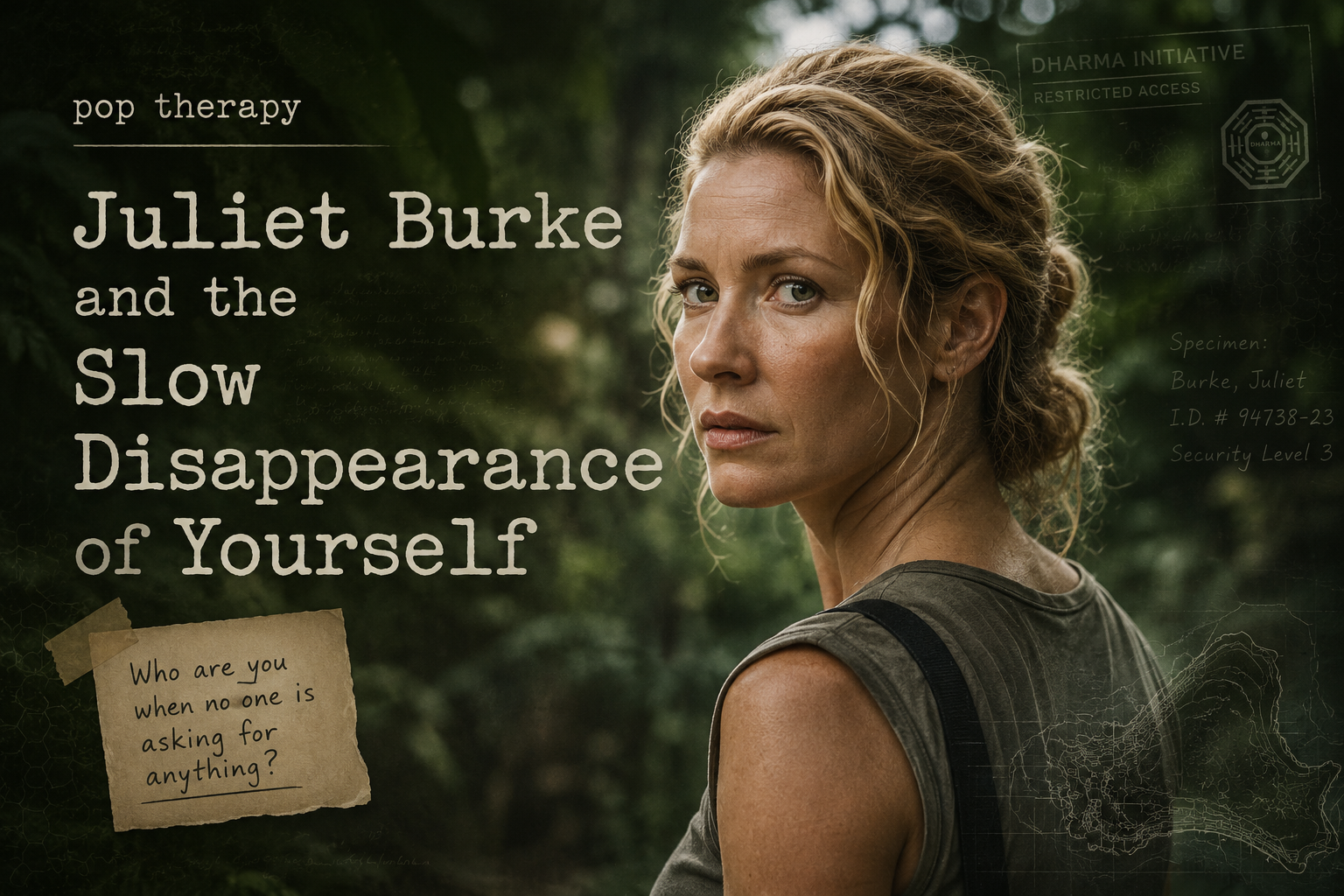
Most people see Juliet as someone who gave up everything for love, but I don’t think that’s really her story. It feels more like she spent years becoming whoever the people around her needed her to be until she slowly forgot she had once been someone else. Ben needed something from her. The Others needed something from her. The fertility project needed something from her. Jack did. Sawyer did. Even the people who genuinely cared about her often leaned on the version of Juliet who could solve problems, keep going, and carry more than her share.
I see that same pattern in therapy. These aren’t dramatic stories. They’re usually thoughtful, capable people who have become so good at adapting that everyone naturally begins relying on them. They read the room before anyone else does. They say yes almost automatically. They anticipate what other people need before they’ve even considered what they need themselves. Over time, a quiet kind of exhaustion settles in. Eventually they say something that almost feels embarrassing to admit out loud: “I don’t really know what I want anymore.”
One of the things LOST understood so well is how identity slips away. It usually isn’t one life-changing event. It’s a thousand small decisions that all make perfect sense in the moment. You accommodate. You adjust. You keep the peace. You tell yourself it’s temporary. Then one day you realize those decisions have started to feel more familiar than the person who made them. Juliet spends much of the series living inside stories that other people have written for her. Ben writes one version. The Island writes another. Even love can become another script if you’re not paying attention.
Therapy isn’t always about dramatic breakthroughs, either. Sometimes it’s simply noticing how many of your choices are driven by avoiding disappointment, conflict, guilt, or rejection. The voice underneath all of that is usually still there. It’s just gotten quieter over the years. Losing yourself rarely happens all at once, and finding yourself again usually doesn’t either. It often begins with one honest conversation. One unexpected no. One decision that isn’t made to keep everyone else comfortable.
That’s the part of Juliet’s story that has stayed with me. Most of us aren’t trying to escape a mysterious island. We’re just trying to remember who we were before we became so good at fitting ourselves around everyone else’s expectations.
Interested in giving therapy a try? I offer a free consultation to see if things are a good fit.
Jin Kwon The Man Who Thought Love Meant Disappearing Into Duty
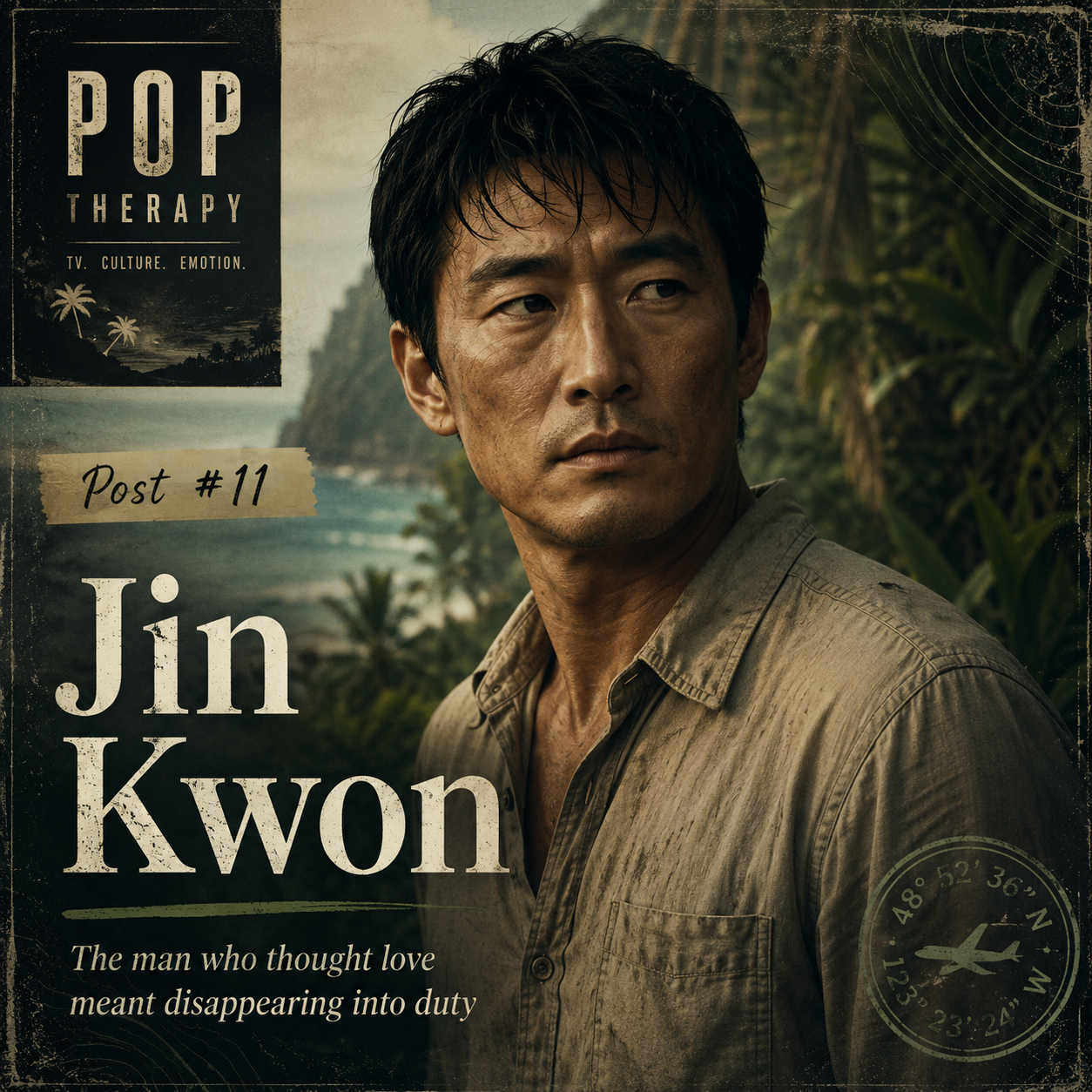
Jin Kwon is easy to misunderstand at first, which is also sort of the point. When we meet him, he seems rigid, controlling, even cold. He watches Sun closely. He tells her what to do. He appears to be the old-world husband who cannot tolerate his wife having a self of her own. And, yes, some of that is there. The show does not let him off the hook, and I don’t think we should either. But Lost is rarely interested in letting first impressions stay intact. The longer we sit with Jin, the more we realize that what looks like control is also shame, class injury, fear, love with nowhere clean to go, and a man who has been taught that tenderness is something you prove by suffering silently.
Before the Island, Jin is a man trying to climb into a life he does not quite believe he deserves. He is the son of a fisherman, ashamed of where he comes from, ashamed of what others might see in him, and desperate to become acceptable in Sun’s world. He does not begin as some cartoon brute. He begins as a man in love who wants to be worthy, which is one of the more dangerous things a person can want if they have no language for their own worth. Wanting to be worthy can become devotion, but it can also become obedience to cruel systems. It can become a job you hate, a version of yourself you barely recognize, a suit you put on until you forget what your own skin feels like underneath.
That is part of what makes Jin’s story so painful. He thinks he is protecting his marriage by doing the very things that destroy it. He works for Sun’s father. He becomes hardened by the work. He absorbs humiliation and violence and then brings that hardness home. He does not tell Sun what is happening because, in his mind, telling her would burden her, or expose him, or reveal that he is not the man he is trying so desperately to become. So she experiences his silence as rejection. He experiences his silence as sacrifice. This is the kind of marital tragedy that happens all the time, even without plane crashes and hatches and smoke monsters. One person says, “I did all this for you,” while the other person is thinking, “But where did you go?”
There is a particular kind of man who believes love is proven through endurance. He may not say it that way. He may not even know he believes it. But somewhere inside him is a rule: don’t complain, don’t explain, don’t need too much, don’t fall apart, just keep going. It can look noble from the outside for a while. It can even be useful. Families survive because somebody gets up and goes to work, pays the bill, makes the call, fixes the thing, carries the heavy box, keeps the machine moving. But when duty becomes the only available language, love starts to get strangely lonely. The people closest to him may be cared for in practical ways and still feel emotionally abandoned.
Jin and Sun become a couple fluent in each other’s defenses but not each other’s hearts. She hides her English. He hides his shame. She plans an escape. He doubles down on the role he thinks will save them. Both of them are living in a marriage full of untranslated sentences. That is one of the more quietly brilliant parts of their story. Language is not just Korean and English here. Language is emotional language. It is the difference between “I am angry” and “I am scared I am not enough.” It is the difference between “you betrayed me” and “I thought I had already lost you.” It is the difference between “I am doing this for us” and “I don’t know how to let you see me failing.”
The Island begins to change Jin because it takes away the old scoreboard. Status does not mean much when everyone is sweating through the same clothes and trying not to get eaten by whatever is moving around in the trees. The things that made him feel small or powerful in the regular world become less useful. He cannot impress Sun’s father there. He cannot work his way into respectability through money. He cannot hide forever inside duty. On the Island, Jin has to become known in other ways. He fishes. He helps. He struggles. He gets jealous. He makes mistakes. He begins, slowly, to become a person instead of only a role.
That is the part I find moving about him. Jin does not transform through some neat therapeutic breakthrough where he suddenly finds the perfect words and everyone claps. His change is slower and more awkward than that, which makes it feel more honest. He learns by doing. He learns by being humbled. He learns through friendship, through failure, through grief, through the terrible realization that love cannot be protected by refusing to be vulnerable. There is something almost old-fashioned about his arc, like a song you forgot was on the second side of a cassette and then it catches you off guard while you’re driving around at dusk. Not flashy. Not clean. But it stays with you.
In therapy, I think a lot about men like Jin. Not because they are all secretly noble or misunderstood, and not because harm gets erased if we can explain where it came from. Explanation is not absolution. But if we only look at the behavior from the outside, we miss the machinery underneath it. Control may be control, but it may also be panic wearing a uniform. Silence may be silence, but it may also be a man trying to keep his shame from spilling onto the floor. Anger may be anger, but it may also be the only emotion he was ever allowed to carry in public.
The work, then, is not to applaud the suffering or excuse the damage. The work is to help a man come out from behind the role before the role costs him everything. For Jin, the role is husband, provider, protector, man of honor, man who can withstand anything. Those roles are not bad by themselves. They only become dangerous when they leave no room for softness, apology, confusion, dependence, or repair. A man can become so committed to being strong that he becomes unreachable. Then the people who love him are left trying to have a relationship with his armor.
Sun and Jin’s story is ultimately not about a bad husband becoming a good husband in some simple moral arc. It is about two people trying to find each other after years of hiding in plain sight. It is about how marriage can become a place where both people are lonely for different reasons. It is about the strange grief of realizing the person you loved was there the whole time, but buried under fear, pride, family pressure, and a thousand unsaid things. Their love is not sentimental because it has too much wreckage in it. It has betrayal in it. It has control in it. It has secrecy in it. And still, somehow, it also has devotion.
That is why Jin matters. He reminds us that change is not always a person discovering a brand-new self. Sometimes change is a person returning to the self that got covered over by shame. Sometimes it is learning that being loved is not the same thing as being useful. Sometimes it is realizing that the people closest to us do not need us to disappear into sacrifice. They need us to come back, sit beside them, and tell the truth in whatever broken language we have available.
Jin’s tragedy is that he had to lose so much before he could become reachable. His gift is that he did become reachable. Not perfectly. Not magically. Not without causing pain. But enough for us to see the man beneath the duty, the husband beneath the armor, the frightened son beneath the clenched jaw. And maybe that is why his story still works. Because somewhere in him is the part of us that thought love meant carrying everything alone, when what we really needed was to turn toward someone and let them see the weight.
The Jealous Part of Us Is Usually the Younger Part of Us
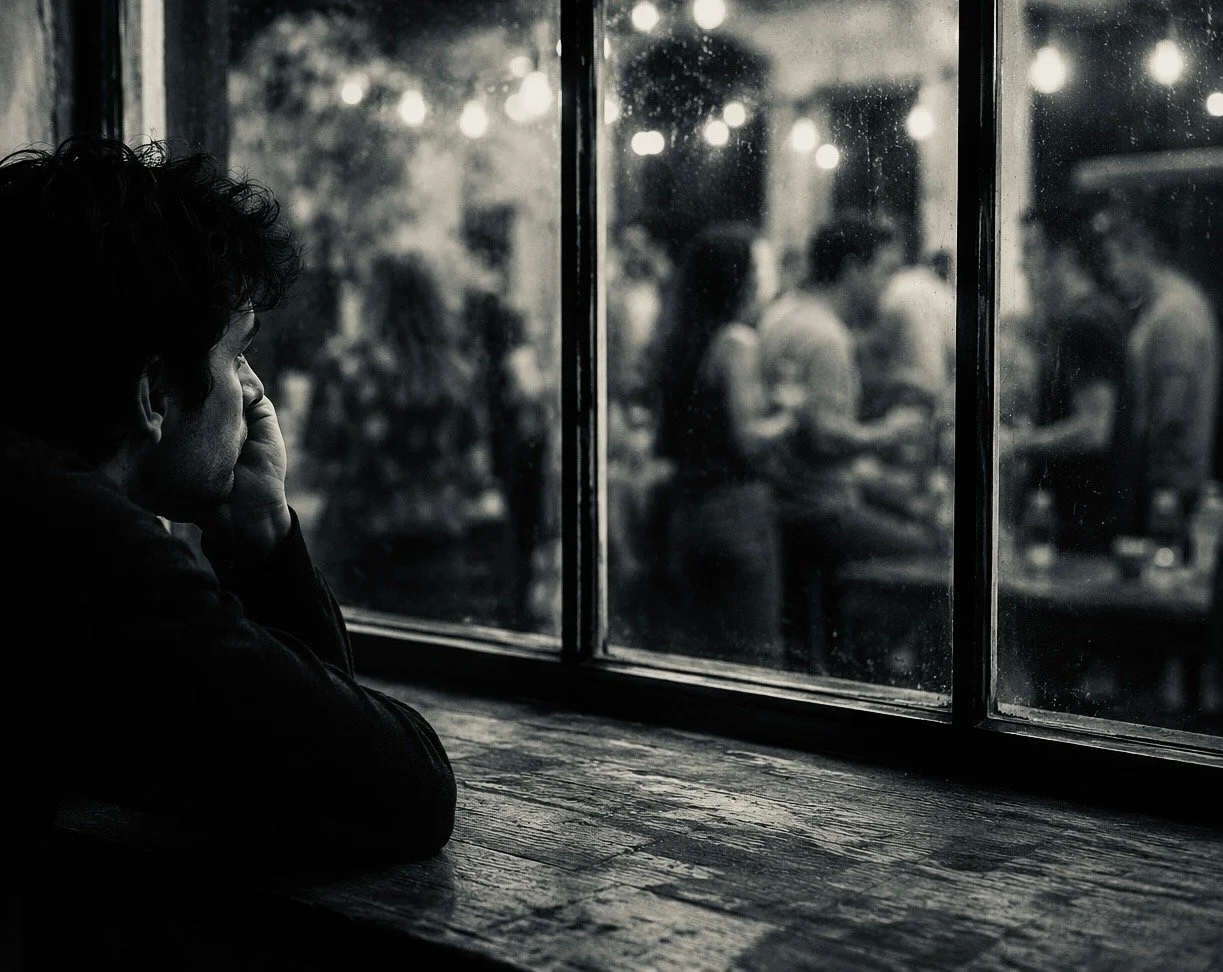
Nobody wants to admit they are jealous.
It’s one of those emotions we try to dress up before anyone sees it. “I’m not jealous. I just think it’s weird.” “I’m not insecure. I just have a question.” “I don’t care. I just noticed.”
And sometimes that’s true. Sometimes we really are noticing something important. Sometimes our instincts are picking up on a relationship problem that needs attention. But sometimes jealousy isn’t showing us what’s happening now. Sometimes jealousy is showing us what happened before.
Most of us think jealousy sounds like: “I don’t trust you.”
But underneath, it often sounds much more like: “I don’t trust that I’m enough.”
That’s a much harder thing to say. It’s easier to ask, “Who were you talking to?” than it is to say, “I saw you connecting with someone and suddenly I felt small.” It’s easier to investigate someone else than sit with the terrifying possibility that some old part of us believes we are replaceable.
Jealousy has a way of turning us into detectives. We start collecting little pieces of evidence. They laughed harder with someone else. They seemed happier without us. Someone else looks more successful, more attractive, more interesting, more confident.
And before long we aren’t really looking at the other person anymore. We’re looking into a mirror. A very unflattering mirror. The kind that only shows every insecurity we already carry.
A lot of jealousy lives in time travel.
Something happens in the present, but emotionally we are suddenly somewhere else. We’re back to being the kid who felt left out. The teenager who wasn’t picked. The person who was betrayed. The version of ourselves who decided, “Of course they would choose someone else.”
Our brain is trying to protect us. It scans for danger because at some point danger felt real. The problem is that our brain isn’t always great at knowing whether we’re facing a current threat or an old wound.
So we try to solve the feeling.
We check. We compare. We ask for reassurance. We replay conversations. We try to make absolutely sure we won’t get hurt.
But insecurity is rarely satisfied by more evidence.
Because the question underneath was never really: “Can I prove they won’t leave?”
The question was: “What happens inside me when I imagine they could?”
That’s where the work begins. Not by shaming the jealous part. Not by pretending we’re above it. By getting curious.
“When did I first learn this feeling?”
“When have I felt like this before?”
“What part of me is trying to get my attention right now?”
Because sometimes jealousy is not actually saying: “Control this person.”
Sometimes it’s saying: “Come find me.”
There’s a younger version of yourself who got scared somewhere along the way. And maybe the goal isn’t to finally prove that you’ll always be chosen by everyone else.
Maybe the goal is learning how to stop abandoning yourself every time you’re afraid you won’t be.
Sun Kwon and the Hidden Life We Carry
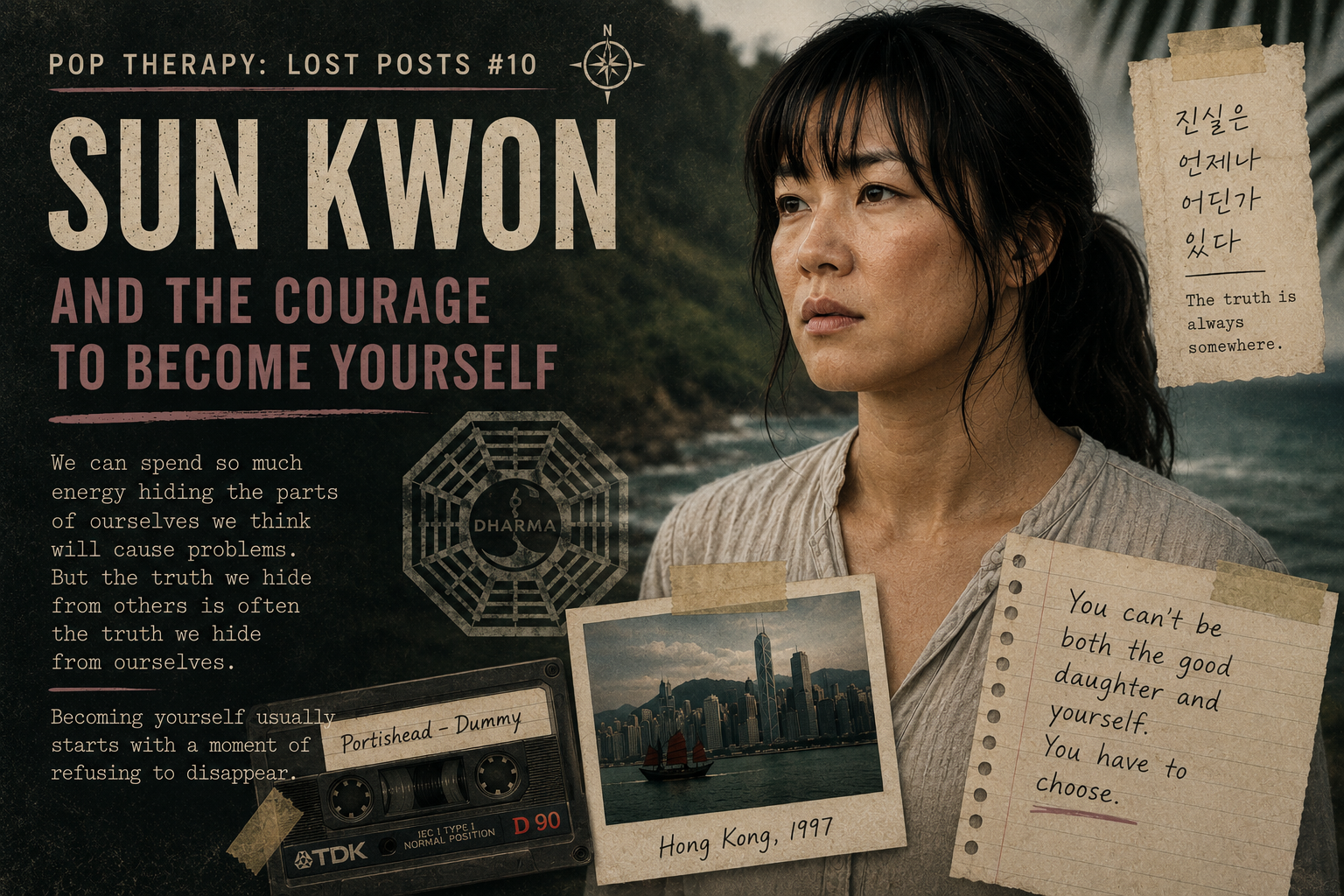
When people talk about Sun Kwon from Lost, they often focus on her transformation. They talk about confidence. Independence. Finding her voice. Those things are certainly part of her story. But I think there is something else happening underneath it all, something quieter and more familiar.
Sun spends much of her life becoming the person other people need her to be.
At first glance, this doesn't seem like a problem. Most of us do it. We learn what keeps the peace. We learn what earns approval. We learn which parts of ourselves fit comfortably into the family story and which parts are better left in the dark. The process is so gradual that it rarely feels like a choice. It feels like maturity. Responsibility. Love.
Then one day you wake up and realize you've become an expert in everyone else's expectations while remaining a stranger to yourself.
When we first meet Sun, she appears quiet and compliant. She translates. She observes. She smiles politely. Around her husband, Jin, she often seems smaller than she really is. It's easy to mistake this for weakness. But weakness isn't the right word. What we're seeing is adaptation.
People who grow up in demanding families often become remarkably skilled adapters. They develop an almost supernatural ability to read the room. They know when to speak. They know when to stay quiet. They know what version of themselves will create the fewest problems.
The trouble is that adaptation works.
At least for a while.
It protects relationships. It prevents conflict. It keeps the family system functioning. It can even earn admiration. The person becomes known as dependable, selfless, easygoing, mature. Everyone benefits from the arrangement except the person living it.
Therapy clients often arrive carrying this exact dilemma.
They don't usually say, "I've lost myself."
Instead, they say things like:
"I don't know what I want."
"I should be happy."
"Nothing is wrong, but something feels off."
They describe a vague loneliness that follows them around even when they're surrounded by people who care about them. Somewhere along the way, they became so focused on maintaining connection that they lost contact with themselves.
Sun understands this kind of loneliness.
One of the most interesting things about her story is that she doesn't simply hide things from other people. She hides things from herself. Her desires. Her anger. Her ambitions. Her disappointment. She keeps them tucked away because acknowledging them would create consequences.
The hidden self is often born this way.
Not from deception, but from self-protection.
A child learns that honesty creates tension. Vulnerability creates risk. Certain feelings make other people uncomfortable. So those feelings are packed away like old boxes in an attic. Years later, the person has forgotten they put them there.
The island has a way of bringing those boxes back downstairs.
That's what makes Lost such an enduring therapy show. The island rarely creates problems. More often, it exposes them. It strips away distractions and asks a question most people spend years avoiding:
Who are you when the life you've built can no longer contain the truth?
For Sun, that truth arrives slowly. It isn't one dramatic moment. It's a series of moments. Small acts of honesty. Small refusals. Small acknowledgements that her inner life matters too.
Real change often looks like that.
Movies teach us to expect breakthroughs. Therapy is usually more interested in recoveries.
Recovering your preferences.
Recovering your voice.
Recovering your anger.
Recovering your capacity to disappoint people and survive.
The people-pleasers I work with are often surprised by how uncomfortable this feels. They imagine authenticity will feel liberating from the start. More often it feels terrifying. When you've spent years managing everyone else's emotional weather, choosing yourself can feel strangely selfish.
It isn't selfish.
It's simply unfamiliar.
The irony is that relationships often improve when people stop disappearing inside them. Partners become easier to know. Friendships become more honest. Conversations become less performative. The very thing people fear will destroy connection often creates a deeper version of it.
By the end of Lost, Sun is still compassionate. Still caring. Still devoted to the people she loves. She doesn't become someone else.
She becomes more fully herself.
That distinction matters.
Therapy isn't about creating a new person. It isn't about becoming fearless, perfectly confident, or endlessly self-assured. More often, it's about reclaiming pieces of yourself that were abandoned in the service of survival.
The hidden life you've been carrying all these years may not need to be reinvented.
It may only need to be remembered.
Somewhere in the mid-1990s, while somebody sat alone listening to Dummy by Portishead and staring out a rain-streaked apartment window, they were probably wrestling with the same question Sun eventually faces: What if the person everyone likes isn't quite the same person I am? It's an uncomfortable question. But sometimes it's also the beginning of a more honest life.