
Desmond Hume and the Problem of Living in the Future
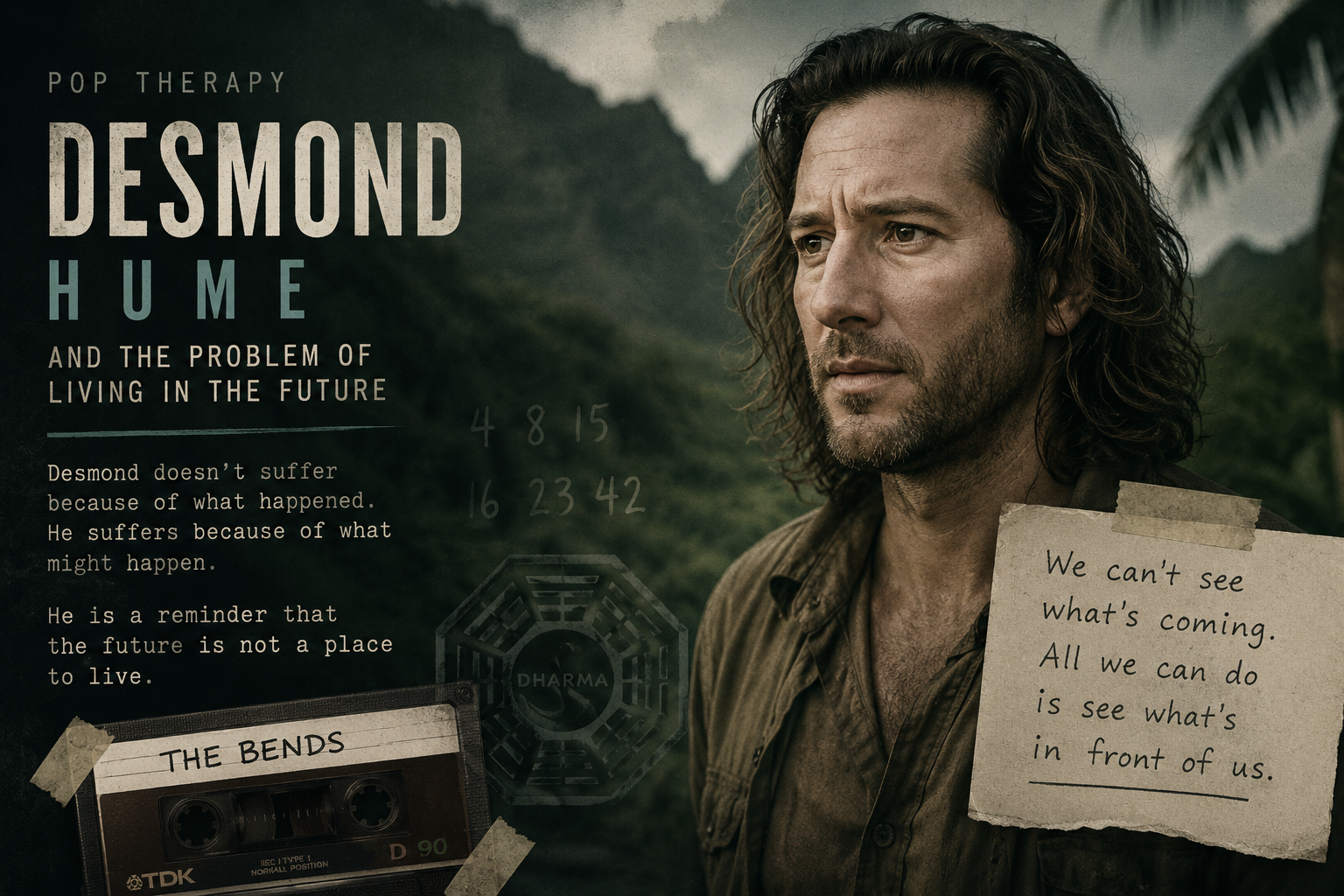
There is a particular kind of suffering that doesn't come from the past. Most of us are familiar with old wounds, old losses, old humiliations. We know what it is like to replay an embarrassing moment from ten years ago while standing in the shower. We know what it is like to have a conversation with someone who isn't even in the room anymore. But Desmond Hume reminds us that people can become trapped by the future just as easily as they can become trapped by the past.
When we first meet Desmond on Lost, he seems like an odd side character. He lives alone in a bunker. He enters numbers into a computer every 108 minutes. He carries a weapon. Mama Cass plays on his turntable. He looks exhausted. He seems to be carrying around some enormous burden that nobody else can quite understand. As it turns out, we learn that his burden is not really the button or the island - it’s the belief that catastrophe is always just around the corner and that it is his responsibility to stop it. No pressure.
Many people who come to therapy know this feeling intimately…
They may not be preventing electromagnetic disasters, but they are scanning constantly for the next thing that could go wrong. They rehearse conversations before they happen. They imagine worst-case scenarios. They build elaborate mental maps of possible futures. They become convinced that if they think hard enough, prepare carefully enough, or worry intensely enough, they can somehow gain control over what comes next. That happens to be what depression looks like - trying to think your way out of an emotional problem. Trust me, the square peg is never going to fit.
The trap, of course, is that the mind begins treating imagined futures as if they are already real.
I often think anxiety gets described incorrectly. People talk about fear as though it is simply fear. More often, anxiety feels like responsibility. The anxious person is rarely sitting around thinking, "I am scared." Instead, they are thinking, "I need to figure this out." They are trying to solve a problem that hasn't happened yet. They are attempting to manage outcomes that do not yet exist. They become project managers for futures that may never arrive.
Desmond lives almost entirely in this state - never quite in the present moment.
After his flashes through time begin, he becomes obsessed with changing outcomes. He sees Charlie die. Then he sees it again. And again. Each time, he intervenes. Each time, he postpones the inevitable. His efforts are understandable. They are compassionate. They are also exhausting. Desmond becomes trapped in a cycle familiar to many anxious people: the belief that vigilance is the only thing standing between order and catastrophe.
At first, this feels empowering - if the future depends on me, then I matter.
If I can prevent disaster, then I have purpose.
If I stop worrying, something terrible might happen.
This bargain works for a while. Then it starts charging interest.
What began as concern becomes hypervigilance. What began as preparation becomes obsession. Life shrinks. Relationships become secondary. The present moment becomes little more than a staging area for future emergencies.
I think this is why Desmond's relationship with Penny matters so much.
Penny is not simply a love interest. She represents something much larger. Throughout the series, she functions almost like an anchor to reality itself. When Desmond is pulled across timelines, consciousness, memories, and possible futures, it is Penny who helps him find his way back. Not because she has all the answers, but because she connects him to something that exists right now.
The older I get, the more I think healing often involves finding our own version of Penny.
Not necessarily a person. Sometimes it is a relationship. Sometimes it is a creative practice. Sometimes it is a garden, a community, a spiritual tradition, or even a daily walk through the neighborhood. Something that keeps pulling us back to the life that is actually happening instead of the life we are trying to predict.
The challenge is that many of us secretly believe our worrying is helping. We treat anxiety like an unpaid intern who works around the clock. Sure, it is annoying, but maybe it is getting something done. Maybe all that forecasting and preparation is keeping disaster at bay.
Yet when you listen carefully, most anxious people are not enjoying the benefits of certainty. They are enduring the costs of uncertainty while convincing themselves they are gaining control.
Desmond eventually learns something many therapy clients struggle to learn: there is no finish line where uncertainty disappears. There is no final prediction that makes the future safe. There is no perfect amount of preparation that guarantees nothing painful will happen.
Life remains uncertain.
People leave and relationships change.
Dreams fail and bodies age.
Plans simply collapse…
And somehow, despite all of that, people continue.
That may be the most radical idea in all of Lost. Not that destiny exists. Not that everything happens for a reason. Not even that time can be changed. The radical idea is that human beings can survive uncertainty without conquering it.
Desmond spends much of the series trying to control what comes next. The moments that feel most meaningful are the ones when he finally reconnects with what is already here.
Maybe that is the invitation his story offers the rest of us - not to stop caring about the future.
Not to stop planning and hoping.
Just to notice when we have wandered so far into the future or past timelines that we have forgotten to live in the present.
Somewhere in the mid-1990s, while some kid listened to The Bends for the hundredth time, someone probably had the same realization: no amount of thinking can cure emotional numbness or substitute for being alive. The future eventually arrives on its own schedule. In the meantime, there is a life happening right here, messed up and unfinished, waiting for our attention.
Interested in booking a therapy session with me?
I recorded a short reflection in my office about why Desmond's story continues to resonate and what it might teach us about waiting for our lives to begin.
Desmond Hume spent years waiting for his life to begin.
Waiting for the right time. The right answer. The right sign that it was finally okay to move forward.
In therapy, I often meet people who feel similarly stuck—living in the future, replaying the past, or waiting for certainty before taking the next step.
A few thoughts on what Desmond's story from Lost might have to teach us about time, fear, and the lives we keep postponing.
Read the full Pop Therapy article at https://www.menstherapykansascity.com.
#Lost #DesmondHume #PopTherapy #MensTherapy #KansasCityTherapist
Why Gen Z Might Need Lost More Than We Did
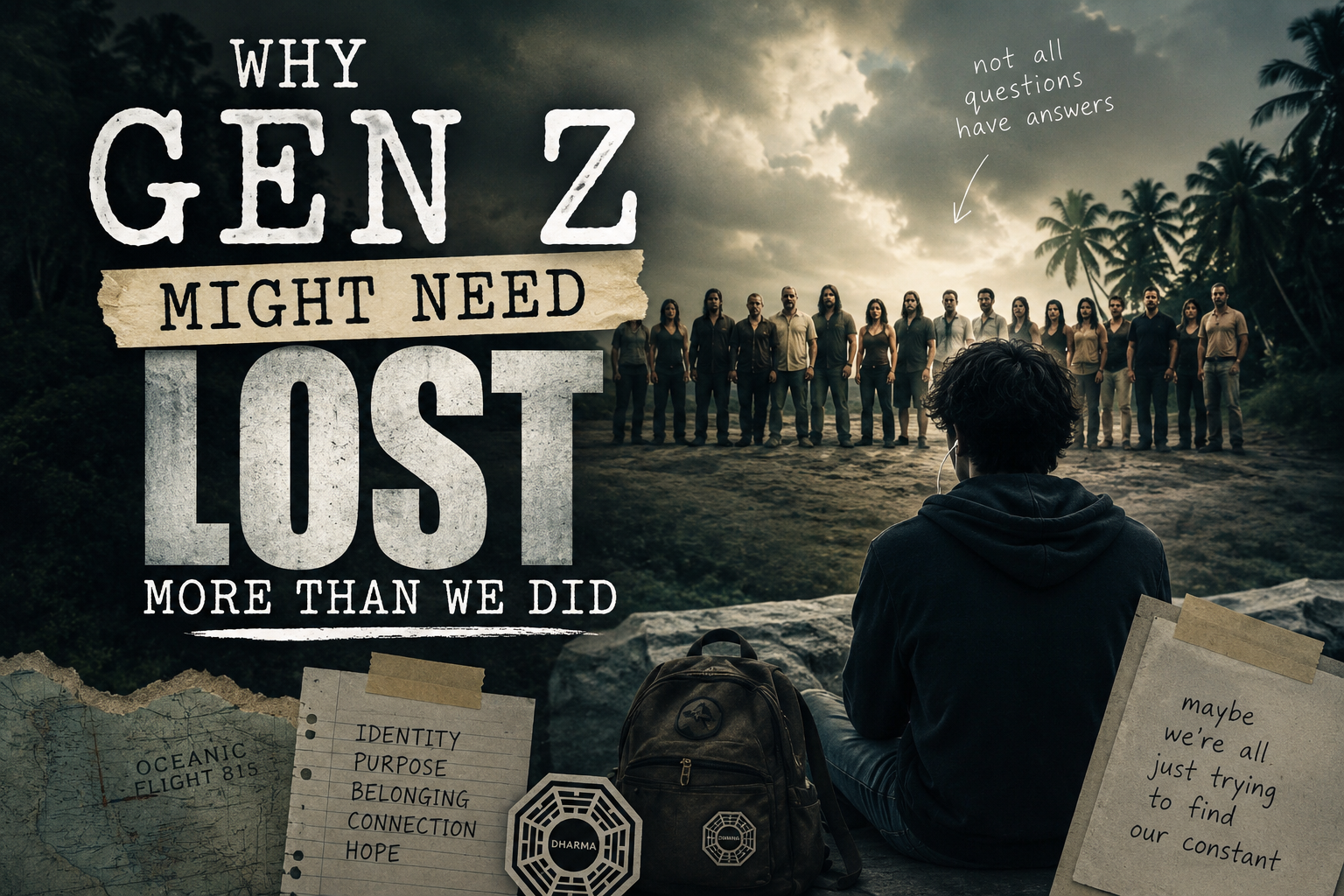
The strange thing about Lost turning twenty is that the people discovering it now weren’t even alive when Oceanic 815 crashed.
Some of them were toddlers when the finale aired. Some were born after Jack closed his eye in the bamboo forest. They did not wait a week to find out what was in the hatch. They never argued on message boards. They don’t remember coworkers discussing the previous night’s episode in the break room. They didn’t experience that particular early-2000s feeling of collectively asking, “What the hell is going on?”
And yet they keep finding the show.
Part of this is simply streaming. Everything eventually becomes available to everybody. But that explanation feels too easy. Plenty of old television sits quietly on servers waiting to be rediscovered. Most of it stays there.
Lost keeps finding new people.
When the show originally aired, many of us were roughly the same age as Kate, Sawyer, Charlie, and Sayid. We were beginning careers, starting families, wondering whether we’d chosen correctly, and quietly carrying the suspicion that adulthood might not feel as solid as we’d been promised. The island became a place where those questions could be asked out loud.
But younger viewers are arriving at the show from a completely different country.
They grew up online.
Many have never known a world without social media, algorithmic recommendations, endless comparison, or the sense that their identities are being assembled publicly in real time. Their photographs are archived. Their opinions are searchable. Their mistakes are documented. The pressure to know who you are seems to begin earlier and earlier, often before anyone has had a chance to become anybody.
Then they watch a television show in which a group of strangers literally lose everything.
No phones. No feeds. No followers. No carefully maintained versions of themselves. The lawyer is just a frightened man. The con artist becomes a caretaker. The addict is forced to confront his addiction without distraction. The successful surgeon discovers that competence does not protect him from fear.
The island strips everyone down to the questions underneath the biography.
Who are you when your old story stops working?
That question may feel more relevant now than it did twenty years ago.
The characters on Lost spend very little time trying to optimize themselves. They are not building personal brands. Nobody talks about productivity hacks. Nobody is curating their life. They are trying to forgive themselves, reconnect with people, survive grief, and decide whether change is possible.
That kind of sincerity can feel almost shocking now.
Modern culture often teaches us to stand outside our own experiences. Everything becomes content, commentary, reaction, or irony. We learn to joke about our pain before we feel it. We anticipate criticism before anyone criticizes us. Somewhere along the way, earnestness became embarrassing.
Lost never received that memo.
John Locke genuinely believes people can change. Jack honestly wants to fix things. Hurley wants people to be okay. Desmond spends years trying to save one person because he loves her. Even Ben Linus, the island’s most complicated manipulator, wants to matter to someone.
The show risks looking foolish in the pursuit of meaning.
Perhaps that is exactly why younger viewers connect with it.
For Gen X viewers, Lost may function partly as nostalgia. We remember where we were when it aired. We remember the music, the commercials, the old televisions, the strange pleasure of waiting.
For Gen Z viewers, the show feels almost archaeological. People sit together without looking at phones. They argue face to face. They wait. They get bored. They stare into the distance. Entire scenes unfold without anyone documenting them.
The island itself begins to feel less like science fiction and more like a place where attention still exists.
This does not mean younger people are somehow longing to become older generations. Every generation imagines the previous one had something easier. That is probably never true.
But every generation inherits different problems.
If Millennials inherited uncertainty, perhaps Gen Z inherited infinite possibility. If we feared being stuck, they often fear choosing incorrectly. If we worried about not being enough, they worry about becoming the wrong version of themselves before they have even begun.
Lost offers a different possibility.
You are allowed to begin again.
You are allowed to become someone else.
Your worst day does not have to become your identity.
And perhaps the most radical idea the show still offers is this: other people matter.
Jack needs Hurley. Sawyer needs Juliet. Charlie needs Claire. Locke needs someone to believe him. None of them heal alone. None of them figure themselves out in isolation.
The island is frightening, confusing, and often unfair, but it insists upon one thing.
We survive by becoming known.
Maybe that is why people born after the show ended continue to discover it.
Not because they need answers.
Because they are still asking the same questions.
And somewhere, on an island that exists outside of time, a group of damaged people continue building shelters, making campfires, and reminding one another that nobody was ever supposed to do this alone.
As Michael Stipe sang sometime around the first Clinton administration, “Find the river.” Sometimes it takes a plane crash to realize you were looking for it all along.
Daniel Faraday and the Problem of Thinking Your Way Out of Life
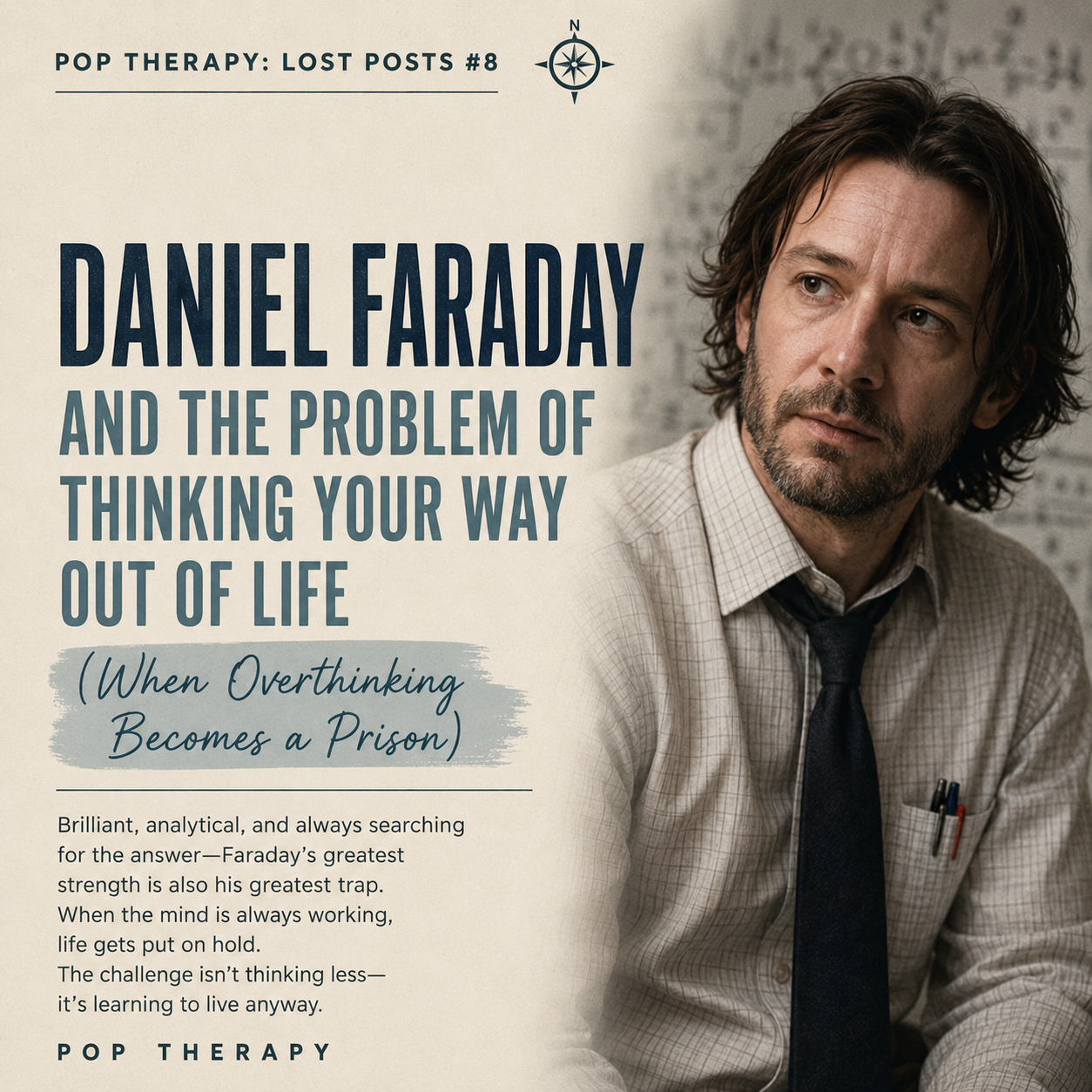
One of the reasons Daniel Faraday stands out to me among the characters on Lost is that he doesn't arrive on the Island carrying a weapon or a grand destiny. He arrives carrying notebooks. While everyone else is reacting to the latest crisis, Faraday is usually hunched over a page somewhere, trying to understand what is happening. There is something comforting about that image. If the world becomes confusing enough, maybe the answer is to study it. Maybe if you can gather enough information, connect enough dots, and build a model that explains everything, the confusion will finally settle down into something manageable.
The trouble is that life doesn't always cooperate with that arrangement. There are experiences that refuse to become theories or patterns. Grief is like that. Love is like that. Loneliness is like that. You can spend years developing an incredibly sophisticated understanding of why you feel the way you do, and still find yourself staring at the same decisions, the same fears, and the same unanswered questions. Knowing and living are related to each other, but they are not the same thing. Sometimes they are not even close.
I've noticed that some of the most thoughtful people I meet are also the people who feel the most stuck. They are rarely impulsive. They are rarely reckless. In fact, they have usually considered every possible outcome before taking a step. By the time they sit down in my office, they can explain their history, their family dynamics, and their emotional patterns with remarkable clarity. They know what happened. They know why it happened. They know what they probably ought to do next. What they can't quite figure out is why all of that knowledge hasn't translated into movement.
Part of what makes that so difficult is that thinking feels productive. It feels responsible. If someone spends an entire Saturday drinking, they usually know they avoided something. If someone spends an entire Saturday scrolling their phone, they usually know they avoided something. If someone spends an entire Saturday reading articles, making plans, researching options, comparing possibilities, and trying to determine the perfect course of action, that can feel very different. It can feel like progress. Sometimes it is progress. Other times it is simply a more socially acceptable way of postponing the risk that comes with participation.
Faraday fascinates me because his intelligence is both a gift and a refuge. Again and again, he finds himself confronted by situations that cannot be solved through understanding alone. The Island keeps demanding something more from him. It demands contact with uncertainty. It demands action before certainty arrives. It demands that he step into experiences that cannot be fully explained ahead of time. The equations matter, but eventually the equation runs out and life is still standing there waiting.
I think that is the place where many people get stranded. They imagine that confidence will arrive first and action will follow. They imagine there will be a moment when the fog clears, every variable is accounted for, and the correct choice becomes obvious. Yet most of the meaningful things we do happen under much messier conditions than that. Relationships begin before we know how they will end. Creative projects begin before we know whether they will work. Difficult conversations begin before we know how the other person will respond. We move, not because certainty finally arrived, but because we became willing to proceed without it.
Watching Faraday now, years after first seeing the show, I find myself less interested in the science fiction aspects of his character and more interested in what he represents. He reminds me of the part of all of us that wants one more answer before taking the next step. One more book. One more insight. One more piece of information. Meanwhile life keeps waiting patiently off to the side, asking a much simpler question: Are you ready to participate yet?
Maybe that's why his story lingers with me. Not because he studies time, but because he seems trapped by the same temptation that catches so many of us. The temptation to believe that if we can understand life well enough, we won't have to risk living it. The Island never lets him get away with that for very long, and in a strange way, neither does life.
What Lost Taught Me About Therapy
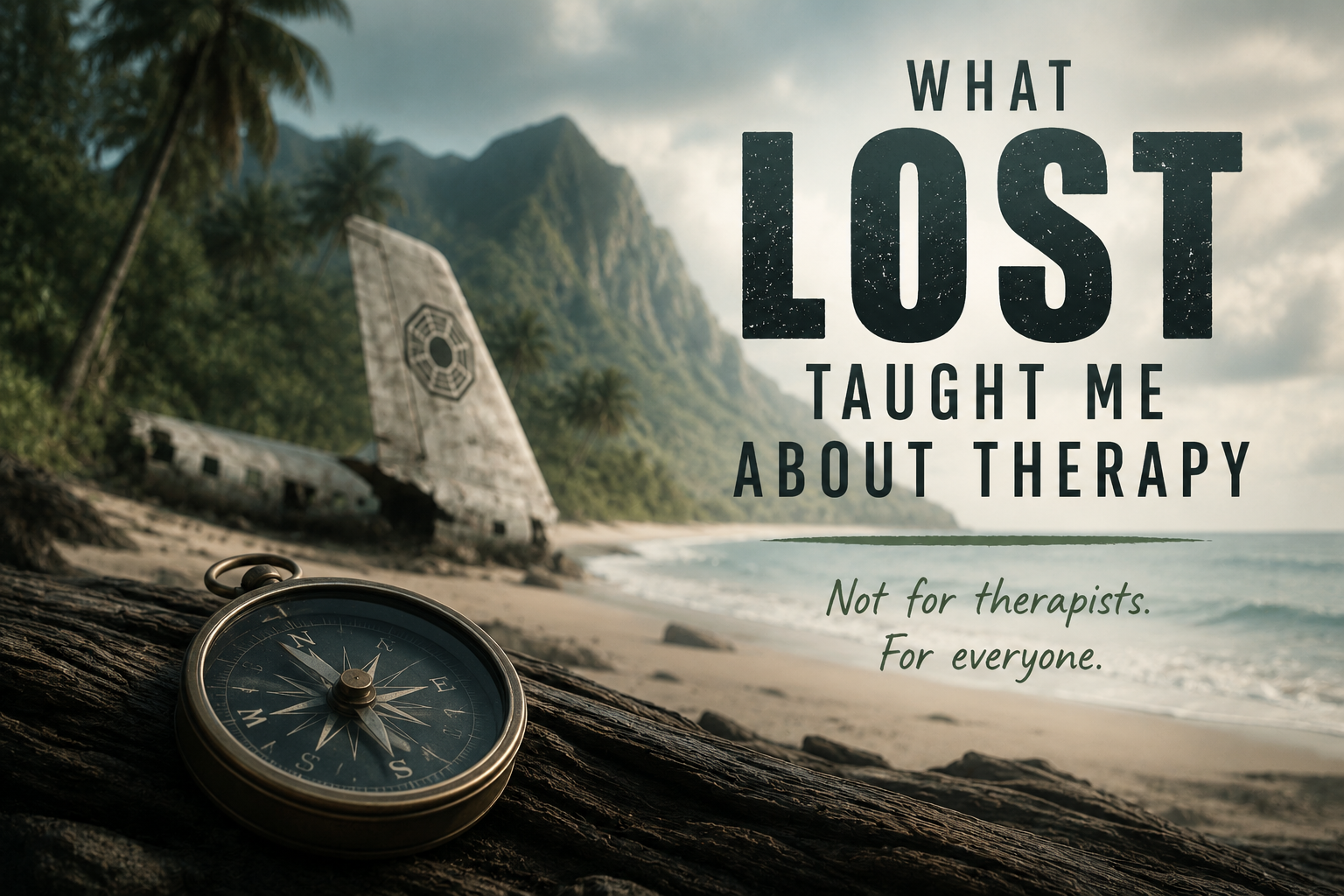
Years ago, when I first watched Lost, I thought it was a show about survival. A plane crashes on a mysterious island, strangers are forced to work together, and everyone is trying to figure out how to get home. Like millions of other viewers, I spent years obsessing over the mysteries. What was the smoke monster? What was the hatch? What was really going on?
Then I became a therapist.
Somewhere along the way, I realized that Lost was never actually about the island. It was about time.
Every character arrived carrying a past that refused to stay dead. The show used flashbacks to reveal old wounds, unfinished business, regrets, and betrayals. The island might have been the stage, but the real struggle was happening inside the characters, who were constantly reacting to ghosts from years before.
What struck me later was how profoundly familiar that felt.
Most people who come into my practice aren't just struggling with what is happening today. They are struggling with today’s situation plus every historical version of that situation that came before it. A disagreement with a spouse isn't just a disagreement with a spouse; it carries the heavy echoes of a critical parent, an absent partner, or a humiliating experience from childhood. The past rarely stays politely in the past.
At the same time, many of us are living somewhere else entirely: the unwritten future. We rehearse divorces before the conversation even begins. We anticipate the rejection before dialing the number. We mourn the failure before taking the chance. By creating entire emotional realities based on events that exist only in our imagination, the future starts exerting influence long before it arrives.
What fascinated me about Lost was that while the characters were constantly being pulled backward and forward through time, the island was the only place they could actually do anything. The island was where choices were made, where relationships were forged, and where healing occurred.
Therapy works the exact same way.
A large part of my job is helping people recognize when they have wandered into an emotional flashback without realizing it—a moment when an old story suddenly feels more real than the room they are sitting in. Another part of the work is noticing when someone has become trapped in a flashforward. They are no longer responding to the present; they are bracing for a catastrophe they’ve already decided is inevitable.
What therapy offers, at its best, is a return to the island.
Not because the past and future don't matter—they do. But because the present is the only arena where anything can actually change.
Over the years, this metaphor became the foundation for a framework I call Temporal Narrative Therapy. The premise is simple: before we can change a pattern, we have to know where we are standing in time.
Are we reacting to something that happened a decade ago?
Are we bracing for something that hasn't happened yet?
Or are we actually responding to what is right in front of us?
I still think about Lost from time to time. Not because I need answers to the mysteries anymore—most of those stopped mattering. What stayed with me were the characters. They were just people carrying old stories, fearing uncertain futures, and trying to build a life in the middle of it all.
Which, when you think about it, is pretty much all of us.
Beneath the polar bears, smoke monsters, and endless fan theories, the show understood a fundamental human truth: the hardest place to stay is the present. And it is also the only place where we can finally heal.
If this idea resonates with you, you can learn more about my approach, Temporal Narrative Therapy, here.
Ben Linus and the Need to Control Everything
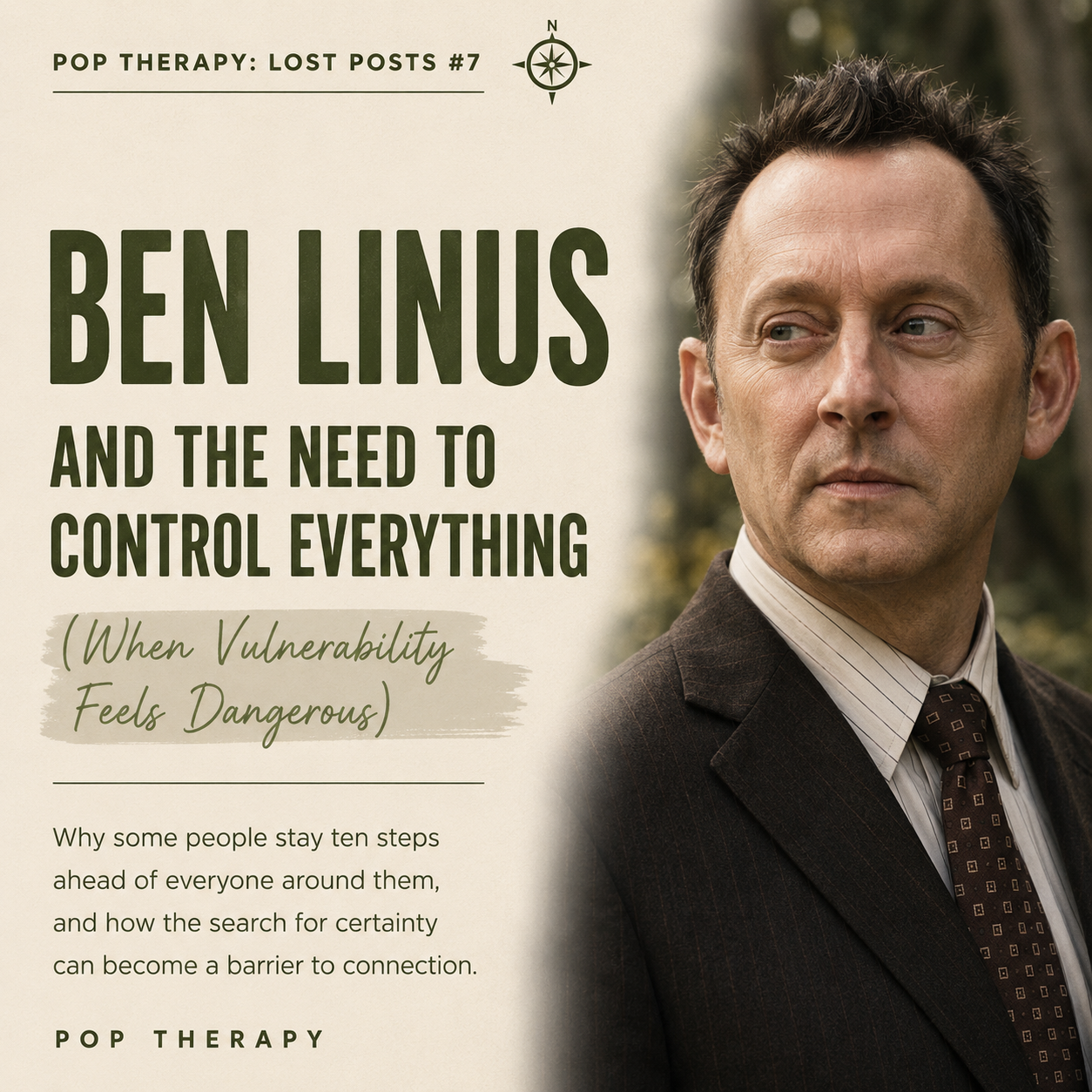
Ben Linus may be the most misunderstood character in Lost. He's manipulative. Deceptive. Secretive. He lies when the truth would be easier. He withholds information that could help people. He always seems to know more than everyone else, and he rarely gives up power willingly. That is his pattern.
It's easy to watch Ben and conclude that he simply likes being in control. I don't think that's quite right. I think Ben is terrified of what happens when he isn't. Underneath all the schemes and manipulation is a person who seems to have reached a painful conclusion very early in life: if you don't stay ahead of people, they will hurt you. If you don't manage the situation, someone else will. If you don't maintain control, you become vulnerable. And vulnerability feels dangerous.
Most people don't become controlling because life has always felt safe. They become controlling because, at some point, life didn't. Sometimes it happens in families where emotions are unpredictable. Sometimes it develops after betrayal, rejection, humiliation, or loss. Over time, control starts to feel less like a preference and more like protection. The problem is that control has a hidden cost.
It can help you manage uncertainty, but it often prevents genuine closeness. It's hard to be known when you're constantly managing what other people see. It's hard to trust when you're always preparing for the possibility that trust will be broken. It's hard to relax when every outcome feels like your responsibility.
Ben spends much of Lost trying to stay several moves ahead of everyone around him. He manipulates situations, anticipates threats, and carefully positions himself to maintain influence. From the outside, it can look like confidence. But confidence and control are not the same thing. Confident people can tolerate uncertainty. Controlling people often cannot. That's why control tends to expand. What starts as a way to stay safe eventually becomes a way of life. More information. More planning. More preparation. More management. More attempts to eliminate risk.
The irony is that the more we try to eliminate uncertainty, the more anxious we often become. Because uncertainty never disappears. There is always another outcome to manage. Another conversation to prepare for. Another threat to anticipate.
Many people eventually discover that their control strategies have become exhausting. They find themselves unable to enjoy good moments because they are already preparing for what could go wrong. They struggle to trust people who have given them no reason to distrust them. They remain vigilant long after the danger has passed.
In those moments, the question is no longer, "How do I stay in control?" The question becomes, "What would happen if I didn't have to?" That doesn't mean becoming passive. It doesn't mean abandoning boundaries or pretending everything will work out. It means recognizing that some forms of control are actually attempts to escape uncertainty. And uncertainty is part of being alive.
What makes Ben such a fascinating character is that beneath all his efforts to manage people and situations, there is a lonely human being trying desperately to protect himself from disappointment, rejection, and loss. Many of us do the same thing in less dramatic ways. We manage. We anticipate. We prepare. We rehearse. We stay one step ahead. Until one day we realize that the strategies designed to protect us are also keeping us from experiencing the very things we want most.
Connection.
Trust.
Peace.
Love.
Pop Therapy Takeaway
Control often begins as protection.
The problem is that what protects us from uncertainty can also prevent us from fully participating in life.
Sometimes growth begins when we stop asking, "How do I control the outcome?"
And start asking, "How do I stay present when I can't?"
Charlie Pace and the Need to Matter
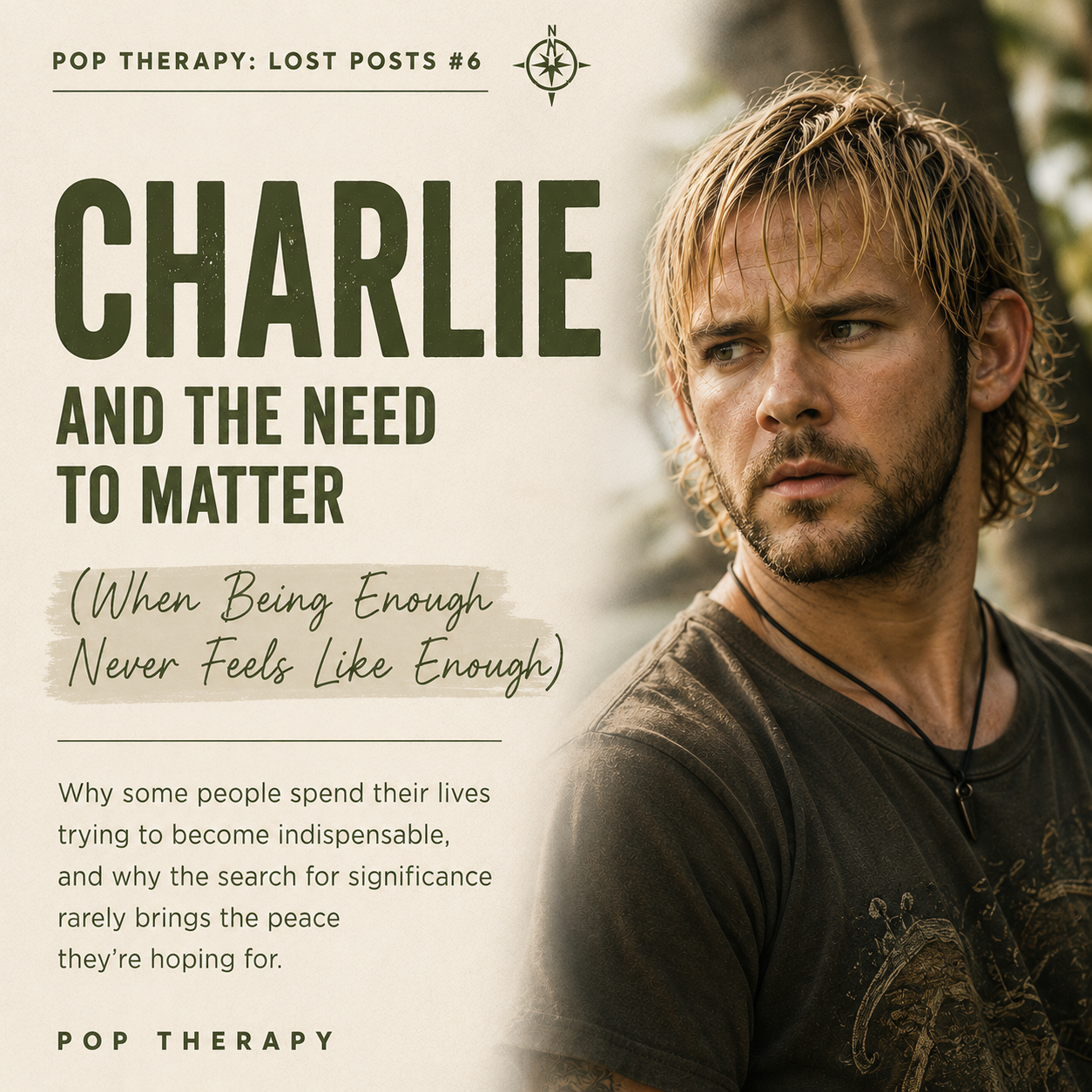
One of the reasons Charlie Pace remains such a memorable character is that his struggle was never really about heroin.
The heroin was real.
The addiction was real.
But underneath both was a question that many people quietly carry:
"Do I matter?"
Long before Oceanic 815 crashed on the island, Charlie was living in the shadow of a story he couldn't escape.
He wasn't the famous one.
He wasn't the successful one.
He wasn't the one people remembered.
His band had become a joke. His career had collapsed. The life he imagined for himself seemed to be slipping away.
Everywhere he looked, there was evidence that he was becoming forgettable.
For Charlie, drugs became a way to manage the pain of that story.
Not because they solved anything.
Because they briefly allowed him to stop feeling it.
Many people think addiction begins with pleasure.
Often it begins with relief.
Relief from shame.
Relief from loneliness.
Relief from the fear that something is fundamentally wrong with you.
The substance changes from person to person.
Alcohol.
Work.
Achievement.
Relationships.
Approval.
Scrolling.
Distraction.
But the question underneath often sounds familiar:
"How do I stop feeling like I am not enough?"
The tragedy is that the harder we try to escape that feeling, the more power it gains.
Charlie spends much of Lost trying to prove his worth.
He wants Claire to trust him.
He wants the survivors to respect him.
He wants to be seen as reliable.
Important.
Necessary.
But every attempt to force significance seems to create more suffering.
This is a pattern many people know well.
When we feel insignificant, we often try to earn our value.
We become helpful.
Productive.
Funny.
Successful.
Indispensable.
We work harder and harder to secure proof that we matter.
The problem is that proof never lasts very long.
Soon we need more.
And more.
And more.
The island slowly forces Charlie to confront something difficult:
Maybe worth cannot be earned.
Maybe it has to be accepted.
One of the most powerful moments in Charlie's story comes near the end of his journey.
Not because he becomes famous again.
Not because he finally gets everything he wants.
But because he stops organizing his life around proving himself.
For perhaps the first time, Charlie acts from love rather than from insecurity.
He is no longer asking:
"Will this make me matter?"
He is asking:
"What matters?"
That is a very different question.
Many of us spend years trying to become enough.
Trying to become important enough.
Successful enough.
Desired enough.
Needed enough.
Charlie's story suggests a different possibility.
The answer may not be found in becoming more.
The answer may be found in loosening our grip on the belief that we were ever less.
Pop Therapy Takeaway
When people feel insignificant, they often try to become indispensable.
But the need to matter can become a prison.
The goal is not to prove your worth.
The goal is to stop building your life around the fear that you have none.